
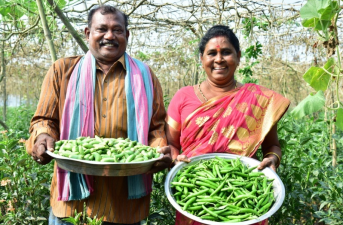
Andhra Pradesh’s Community Managed Natural Farming (APCNF) programme was awarded the 2026 Food Planet Prize, a $1.5 million global honour recognizing its contribution to sustainable food systems. Launched in 2016 by the state government and managed by Rythu Sadhikara Samastha (RySS), the initiative aims to shift the state to 100% natural farming by 2047. It currently supports 1.8 million families and involves over 340,000 women’s self-help groups.
Core Pillars of APCNF
- Zero Synthetic Inputs: Complete elimination of chemical fertilizers, pesticides, and weedicides.
- Soil Rejuvenation: Use of Jeevamrutham (soil inoculant) and Beejamrutham (seed treatment) made from cow dung, cow urine, jaggery, and pulse flour.
- Mulching (Achhadana) & Waaphasa: Maintaining soil cover with crop residues and enhancing soil moisture aeration to drastically reduce irrigation needs.
- Institutional Framework: Peer-led training via Community Resource Persons (CRPs) and institutional leadership by women’s collectives to manage seed banks and local input centers.
- Pre-Monsoon Dry Sowing (PMDS): Utilizing off-season atmospheric moisture for year-round green cover and biomass production.
Impacts and Socio-Economic Benefits
- Economic: Lowers cultivation costs and debt cycles for smallholders by removing dependency on commercial inputs.
- Environmental: Restores Soil Organic Carbon (SOC), conserves groundwater, and improves crop resilience against extreme weather events.
IASPOINT Booster Facts
- Food Planet Prize: Presented annually by the Curt Bergfors Foundation (Sweden); it is the world’s largest environmental award for food sustainability.
- ZBNF Philosophy: Inspired by Subhash Palekar, the method relies on four wheels: Jeevamrutham, Beejamrutham, Achhadana, and Waaphasa.
- National Integration: APCNF learnings are central to the National Mission on Natural Farming (NMNF), a Centrally Sponsored Scheme under the Ministry of Agriculture.
- Replicability: With 6 distinct agro-climatic zones, the model serves as a scalable template for other Indian states and global smallholder-led regenerative agriculture.