
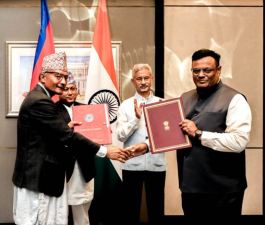
The Digital India BHASHINI Division (DIBD), functioning under the Ministry of Electronics and Information Technology (MeitY), Government of India, signed a Memorandum of Understanding (MoU) with the Centre for Digital Public Infrastructure and Artificial Intelligence (DPI-AI) at Kathmandu University, Nepal. The agreement was exchanged in New Delhi during bilateral engagements between India’s External Affairs Minister Dr. S. Jaishankar and Nepal’s Minister of Foreign Affairs Shishir Khanal. This collaboration focuses on co-creating a National Digital Infrastructure for a ‘Voice First’ multilingual language translation platform to bridge digital and linguistic barriers in the South Asian region.
Key Objectives of the Partnership
The primary objective of this cross-border technology alliance is to build a regional ecosystem for language artificial intelligence and Digital Public Infrastructure (DPI).
- Voice-First Translation Platform: Co-developing a framework that prioritizes vocal interfaces, allowing citizens to interact with digital applications using native speech.
- Overcoming Digital Barriers: Reducing literacy and technological access barriers at the last mile for citizens in both nations.
- Inclusive Public Service Delivery: Supporting the Government of Nepal in deploying digital public services in the native languages preferred by its citizens.
- Socio-Economic Empowerment: Creating regional market opportunities for students, entrepreneurs, and professionals via multilingual access to skill development, education, and digital commerce.
Core Areas of Technical Collaboration
The DIBD and Kathmandu University will align resources to create core blocks of technology for underrepresented languages.
- Dataset Generation: Co-developing high-quality linguistic datasets and localized speech corpora for the Nepali language.
- Natural Language Processing (NLP) Tools: Jointly researching and deploying core tools including speech-to-text (STT), text-to-speech (TTS), and machine translation engines.
- Conversational AI Applications: Designing localized conversational AI modules to assist users in standard public administration workflows.
- Capacity Building: Organizing joint training programs, research workshops, and pilot testing programs involving language experts, technologists, and academic researchers from both nations.
Preservation of Endangered Languages
A major vertical of the MoU focuses on the preservation of local dialects and low-resource languages.
- Digital Decoupling Prevention: Digitizing literary and oral traditions of underrepresented regional languages to prevent them from facing digital extinction.
- Inclusion in Modern AI Frameworks: Creating open-source resources for low-resource languages so that marginalized communities can access modern web tools in their mother tongue.
Understanding Bhashini Architecture
Project BHASHINI operates as India’s National Language Translation Mission. It utilizes an open and interoperable Digital Public Infrastructure model to make artificial intelligence and NLP resources accessible to the public domain, including MSMEs, startups, and individual innovators.
Technical Metrics of BHASHINI
| Parameter | Current Status / Capability |
| Governing Entity | Digital India Corporation (DIC), MeitY |
| Primary Framework | National Hub for Language Technology (NHLT) |
| Website Integration | Powers over 800 government websites |
| Daily Scale | Processes more than 15 million inferences daily |
| Language Coverage (Text) | Supports 36 Indian text languages |
| Language Coverage (Voice) | Supports 23 Indian voice languages |
| International Languages | Supports 35 international languages |
IASPOINT Booster Facts for UPSC
- The Bhasa Daan Initiative: A crowdsourcing component under the BHASHINI platform where individuals can contribute to data collection by typing text, validating translated sentences, or recording sentences in local dialects.
- Anuvadini AI Tool: An AI-driven translation tool developed under the AICTE ecosystem that closely aligns with the BHASHINI mission to translate engineering and medical textbooks into scheduled regional Indian languages.
- Constitutional Linkage: While BHASHINI targets all major localized languages, India officially recognizes 22 scheduled languages under the Eighth Schedule of the Indian Constitution.
- DPI Export Strategy: This MoU represents an operational expansion of India’s Digital Public Infrastructure (DPI) diplomacy, similar to the cross-border integration of the Unified Payments Interface (UPI) with nations like Nepal, Bhutan, Sri Lanka, and Singapore.