
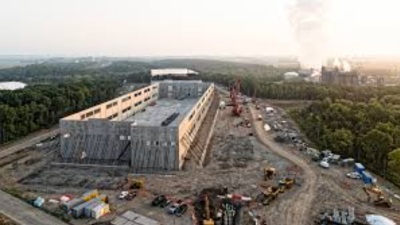
Global opposition to AI data centres is rising over their heavy use of water, electricity and land; India is rapidly expanding hyper-scale capacity through state subsidies and eased environmental oversight.
Resource metrics and operational strain
- Energy footprint: Global data‑centre electricity use ~415 TWh (~1.5% of global demand); projected to double by 2030.
- Compute drivers: Training and inference for LLMs use high-density GPUs with near-continuous power draw.
- Water demand: India’s data‑centre water use projected ~150.3 billion litres, rising to ~358 billion litres annually by 2030; concentration in Bengaluru, Hyderabad and Gurugram risks local groundwater stress.
- Efficiency indices: Power Usage Effectiveness (PUE) aims for 1.0; Water Usage Effectiveness (WUE) tracks litres per kWh.
Regulatory landscape
- Global measures: US and EU use mandatory utility assessments, grid connectivity caps and community consent rules for large projects.
- Indian practice: Data centres often classified as general building or township development under EIA rules, bypassing mandatory public hearings and detailed EIA disclosures.
- State incentives: Maharashtra lowered required round‑the‑clock green power from 100% to 51% and offers subsidised tariffs and capital grants for integrated parks.
Structural trade-offs
- Labour intensity: Hyper‑scale centres are capital‑intensive with limited permanent local employment after construction.
- Policy tension: Fast‑tracking capacity secures onshore processing but, without mandates such as closed‑loop liquid cooling or exclusive use of non‑potable recycled water, shifts long‑term resource costs to local ecosystems.
IASPOINT Booster Facts
- Capacity growth: India data‑centre capacity rose from 375 MW (2020) to ~1.5 GW; state targets aim for ~8 GW by 2030.
- Adani plan: $100 billion proposal targets ~5 GW compute capacity by 2035 linked to the 30 GW Khavda renewables project.
- EPR for hardware: Rules require importers to recycle ~70–80% of specialised processing chips.
- India AI Mission: Allocated ~₹10,300 crore to develop a sovereign compute pool targeting at least 10,000 GPUs for domestic scale‑ups.