
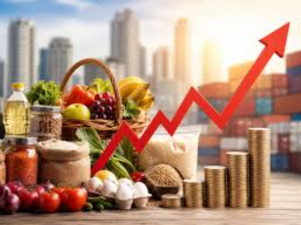
India’s retail inflation, measured by the Consumer Price Index (CPI), rose to 3.93% in May 2026 from 3.48% in April 2026. Data released by the Ministry of Statistics and Programme Implementation (MoSPI) on June 12, 2026, confirmed that headline inflation accelerated by 45 basis points due to a rise in food prices and personal care services. Despite this sharp increase, the headline rate remained marginally below the Reserve Bank of India’s (RBI) medium-term target midpoint of 4.0%, keeping within the official 2% to 6% statutory comfort band.
Structural Breakdown of May 2026 Inflation
The latest data shows a divergence between rural and urban price pressures. Rural inflation remains higher due to its structural sensitivity to shifting food prices.
Rural vs Urban Variations
- Rural Inflation: Registered at 4.25% in May 2026, climbing from 3.74% in April 2026.
- Urban Inflation: Stood lower at 3.53% in May 2026, up from 3.16% in the previous month.
- All-India Index Value: The provisional All-India CPI Combined index for May 2026 reached 105.91.
Food and Core Segment Metrics
The Consumer Food Price Index (CFPI) recorded a major acceleration, jumping to 4.78% in May 2026 from 4.20% in April 2026. Rural areas bore the brunt with food inflation touching 4.85%, while urban food inflation reached 4.66%. Beyond raw food items, food and beverages as a broad group registered 4.55% inflation. Housing inflation stayed moderate at 2.12% nationally, splitting into 2.73% for rural zones and 1.91% for urban spaces.
Sectoral and Item-Level Commodity Trends
Specific high-weight items experienced extreme price volatility during the month, balancing out pockets of deep agricultural deflation.
| Commodity Category | Inflation/Deflation Rate (May 2026) | Economic Context |
| Silver Jewellery | +155.23% | Highest rising item due to precious metal supply squeezes |
| Tomato | +48.43% | Severe seasonal supply disruptions and heatwave impacts |
| Gold/Diamond/Platinum | +40.93% | Global macroeconomic shifts and safe-haven asset demand |
| Ginger | +32.49% | Lower domestic production cycles |
| Potato | -23.71% | Deflation due to bumper cold storage releases |
| Peas | -11.47% | High market arrivals and production surplus |
Service and Miscellaneous Trends
The division comprising personal care, social protection, and miscellaneous goods recorded the highest overall sub-group inflation at 18.46%. Restaurants and accommodation services followed with an inflation rate of 5.75%. Essential social sectors like education services and health services remained stable, posting moderate inflation rates of 2.99% and 1.49% respectively.
Regional Disparities and State-Wise Analysis
Inflation varied widely across individual sub-national economies based on local logistics, state-level taxes, and supply chain efficiencies.
Highest Inflation States (Population over 50 Lakh)
- Telangana: Led the nation with the highest combined retail inflation rate at 6.15%.
- Tamil Nadu: Followed closely, registering a consumer price spike of 5.11%.
- Andhra Pradesh: Recorded high price pressures with a headline rate of 4.90%.
Low Inflation States and Territories
- Mizoram: Recorded the lowest inflation rate in the entire country at 1.03%.
- Tripura: Maintained a highly subdued retail price growth at 2.02%.
- Delhi: Registered a stable inflation profile of 2.50%, aided by urban distribution networks.
Data Collection and Methodology
The National Statistical Office (NSO) collected real-time price data from 1,407 urban markets (including online e-commerce platforms) and 1,465 rural villages. Field staff from the Field Operations Division of NSO visited these locations on a strict weekly roster. The statistical agency achieved a 100% response rate across both rural and urban collection channels during May 2026.
IASPOINT Booster Facts for UPSC
- The New CPI Base Year (2024=100): The May 2026 data represents the fifth reading under India’s updated Consumer Price Index series, which transitioned to a base year of 2024 from the old 2012 base. This change updated item weights based on the Household Consumption Expenditure Survey (HCES), lowering the aggregate weight of food items and raising the share of non-food components like electronics, entertainment, and services.
- CPI vs WPI Responsibility: While the National Statistical Office (NSO) under the Ministry of Statistics and Programme Implementation (MoSPI) compiles and publishes CPI, the Wholesale Price Index (WPI) is released by the Office of the Economic Adviser under the Ministry of Commerce and Industry.
- Inflation Targeting Framework: The Urjit Patel Committee recommendations established the formal inflation targeting framework in India. Under the RBI Act, 1934, the Central Government, in consultation with the RBI, sets the inflation target every five years. The current target is 4% with a tolerance band of +/- 2%.
- Monetary Policy Committee (MPC) Reaction: The sudden jump to 3.93% is expected to prompt a pause from the six-member MPC. The committee had initiated rate cuts earlier in 2026 when headline inflation slid into the 3.21% to 3.48% zone.
- The Base Effect Concept: Inflation measurements utilize a year-on-year calculation method. A low index number in the corresponding month of the previous year creates a statistical “low base effect,” artificially elevating the current year’s inflation percentage even if physical price increases are minor.
