
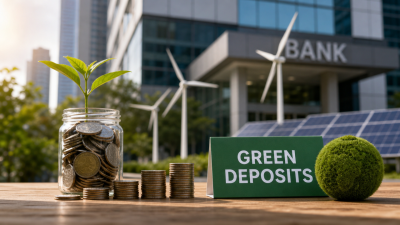
Indian PSU banks recorded a sharp rise in green deposit mobilisation in FY26, nearly doubling to ₹3,733.11 crore from ₹1,831.79 crore in FY25. The RBI Green Deposit Framework, bank-level product launches and project deployments are driving early growth, though green deposits remain a small share of overall deposits.
What is the issue
Green deposits are term deposits where funds are ring-fenced for environmentally sustainable projects. The RBI framework requires disclosure on allocation and use. Recent growth in PSU banks shows market interest. The issue is whether such deposits can mobilise domestic capital at scale to finance renewable energy, clean transport and adaptation needs.
Why it matters for governance and the economy
- Domestic resource mobilisation: Green deposits provide a predictable source of funds for public and private green projects.
- Policy credibility: Transparent reporting under the RBI framework increases accountability in public finance and banking.
- Climate targets and energy security: Channelled funding supports the near-term expansion of non‑fossil capacity, aiding NDC delivery.
- International diplomacy: Domestic instruments affect India’s negotiating position on climate finance and technology transfer.
Regulatory framework and institutional instruments
RBI Green Deposit Framework: Effective from June 2023. Requires banks to disclose allocation, eligible project categories and reporting frequency. It sets baseline transparency but leaves technical standards and external assurance to banks.
Recent trends and bank-level examples
- PSU growth: Green deposit mobilisation by PSU banks rose to ₹3,733.11 crore in FY26 from ₹1,831.79 crore in FY25.
- State Bank of India: Raised ₹317.39 crore in FY26; deployed entirely to clean transportation (electric vehicles).
- Bank of Baroda: Raised ₹1,164.44 crore in FY26; allocated fully to renewable energy. Green deposit portfolio stood at ₹1,899.12 crore.
- Indian Bank: Launched a retail Green Term Deposit product (“IND GREEN”) to expand retail participation.
Deployment areas and absorptive capacity
- Primary sectors: Renewable energy, energy efficiency, clean transport, green buildings, water and waste management.
- Project size: Bankable utility-scale renewable projects absorb larger sums; retail green deposits suit decentralised loans and smaller projects.
- Examples of use: SBI’s deployment to EV financing and BoB’s allocations to renewables show targeted deployment pathways.
Alignment with India’s climate targets
India’s non‑fossil installed capacity reached 53.21%, exceeding the NDC target of 50% by 2030. Green deposits contribute to financing gaps, especially for distributed generation, grid‑integration and clean mobility. However, current mobilisation levels are small relative to estimated investment needs for a rapid low‑carbon transition.
International context and diplomacy
- Climate negotiations: India raised concerns at the Bonn meetings about declining climate finance and the adaptation finance gap. It emphasised equity and historical responsibility.
- Trade and environment outreach: India presented its Carbon Credit Trading Scheme and renewable energy standardisation at WTO forums as part of its market and regulatory response to climate policy.
- Implication: Domestic mobilisation through instruments such as green deposits strengthens India’s negotiating stance, but does not substitute promised international finance for adaptation.
Challenges to scaling green deposits
| Challenge | Implication |
| Small base relative to total deposits | Limited macro impact on overall credit allocation. |
| Awareness and product demand | Low retail uptake reduces stable funding sources. |
| Standardisation and verification | Variation in eligibility, reporting and external assurance creates trust gaps. |
| Perceived risk and returns | Investor preference for conventional deposits limits shift to green instruments. |
| Project pipeline and bank capacity | Insufficient bankable projects and limited green underwriting skills hinder deployment. |
Way forward: policy and institutional measures
- Regulatory enhancements: Strengthen minimum eligibility criteria and standardised reporting templates under RBI guidance. Encourage third‑party assurance for larger allocations.
- Incentives: Fiscal incentives for retail green deposits or concessional capital treatment for banks’ green assets to improve risk‑return profiles.
- Market development: Expand complementary instruments — green bonds, sustainability‑linked loans, and carbon markets — to diversify demand and balance maturities.
- Capacity building: Training for credit officers on green project appraisal and setting up internal green desks in banks.
- Public‑private collaboration: Use partial credit guarantees, blended finance and viability gap funding to make projects bankable.
- Public awareness: Targeted campaigns to inform retail and corporate customers about impact and safety of green deposits.
- International finance alignment: Use domestic instruments alongside demands for predictable international climate finance for adaptation and technology transfer.
Model Questions
- Analyse the role of green deposits as a tool for sustainable finance in India, with reference to the RBI framework and recent trends in PSU banks. What are the implications for India’s transition to a green economy? [GS-III: Economic Development]
- In light of India’s interventions at international climate talks, assess how domestic sustainable finance mechanisms, including green deposits, support India’s negotiating position and NDC delivery. [GS-III: Environment & DM]
- Examine the institutional and policy measures required to scale sustainable finance in India. Discuss how instruments like green deposits and carbon credit trading can be integrated to accelerate the low‑carbon transition. [GS-III: Economic Development]
- Despite recent growth, green deposits remain a small fraction of deposits. Identify the key obstacles to wider adoption and propose pragmatic measures to address them. [GS-III: Economic Development]
Define green deposits and summarise the RBI disclosure framework. Use PSU data (FY26 mobilisation, SBI and BoB deployments, Indian Bank product) to show trends. Analyse benefits: predictable funding, retail engagement, targeted sector finance. Discuss limits: small share of deposits, bankable project pipeline, verification standards. Conclude with implications for funding renewables, EVs and meeting NDCs.
Link India’s diplomatic stance on finance and equity to domestic action: rising non‑fossil capacity and green finance initiatives strengthen credibility. Note showcased carbon trading and renewable standardisation at WTO as policy exports. Evaluate limits: domestic mobilisation can supplement but not replace promised international adaptation finance. Recommend parallel pursuit of domestic instruments and demands for predictable external flows.
List institutional measures: RBI rules, standardisation, third‑party assurance, fiscal incentives, capacity building. Explain integration: use green deposits for upfront funding, green bonds for large projects, carbon credits to monetise emissions reductions and improve project bankability. Address market infrastructure, legal clarity for carbon trading and coordination between ministries and financial regulators.
Identify obstacles: low awareness, trust deficits from uneven standards, limited incentives, small bankable pipeline and perceived returns. Propose measures: standardised eligibility and reporting, tax or interest incentives, guarantee mechanisms, capacity building in banks, retail outreach, and integration with larger instruments (bonds, blended finance) to create durable demand and expand project absorption capacity.