
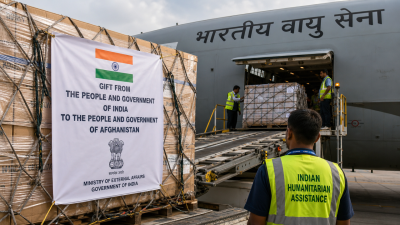
On 17 June 2026 India delivered five tonnes of essential medicines to Kabul, reaffirming sustained humanitarian support to Afghanistan. This follows recent shipments of vaccines, medical equipment and flood relief and reflects a multi-year aid programme reaching all 34 provinces through over 500 projects.
Current issue
India maintains continuous humanitarian engagement with Afghanistan to address acute healthcare shortages, child immunisation gaps and disaster relief needs. Recent consignments include medicines, 33 tonnes of BCG/tetanus/diphtheria vaccines, medical equipment donations and specialised flood relief supplies. Diplomatic statements at the UN and MEA announcements signal an active, state-led assistance effort.
Why this matters
- Governance: Aid supports basic service delivery where Afghan health institutions face resource constraints.
- Public health: Vaccine and medicine supplies reduce preventable disease burden and treatment costs.
- Security and stability: Humanitarian relief mitigates drivers of instability and displacement.
- International relations: Sustained assistance projects Indian soft power and preserves regional influence.
- Humanitarian ethics: Medical treatment for children and specialised centres respond to urgent welfare needs.
Scope and nature of assistance
- Sectoral mix: Healthcare, food security, disaster relief, public infrastructure and skill development.
- Geographic reach: Programmes implemented across all 34 provinces through 500+ projects.
- Recent consignments: Essential medicines; 33 tonnes of vaccines; medical diagnostic and treatment equipment; flood relief kits; prior large-scale wheat and medicine consignments since 2021.
- Specialised support: Medical treatment in India for Afghan children with congenital heart disease and support for a Thalassaemia centre in Herat.
| Dimension | Examples | Scale / Frequency |
|---|---|---|
| Food security | Wheat consignments | Over 50,000 tonnes since Aug 2021 |
| Health | Medicines, vaccines, equipment, medical referrals | 420 tonnes of medicines/vaccines since Aug 2021; recent deliveries ongoing |
| Disaster relief | Flood relief kits, hygiene supplies | Repeated rapid-response consignments |
| Capacity building | Infrastructure, skill development projects | 500+ projects across provinces |
Strategic foreign policy objectives
- Soft power and image: Humanitarian assistance projects present India as a regional partner addressing human needs.
- Regional stability: Relief reduces humanitarian stressors that can fuel displacement and conflict spillover.
- People-to-people connectivity: Medical treatment, training and infrastructure work maintain societal links irrespective of regime changes.
- Geopolitical presence: Continued engagement preserves influence in Afghanistan and supports connectivity goals toward Central Asia.
- Multilateral signalling: Statements at UN forums and consistent deliveries project India’s commitment within international humanitarian norms.
Impact on Afghan socio-economic well‑being
- Health outcomes: Vaccine and medicine supplies support routine immunisation, reduce treatment costs and prevent outbreaks.
- Immediate relief: Flood kits and food consignments provide short-term survival support and reduce acute vulnerability.
- Service continuity: Medical equipment donations enable diagnostic and specialised care where local capacity is weak.
- Human capital: Skill development projects and medical referrals build long-term capacity and trust.
- Local impact limitations: Scale helps many but does not substitute systemic healthcare financing or governance reforms.
Challenges to sustained engagement
| Challenge | Operational implication |
|---|---|
| Security instability | Risks to personnel, interruptions in delivery and constrained access to remote areas. |
| Logistics and last-mile delivery | Poor infrastructure and terrain increase cost and delay; need for reliable transport corridors. |
| Political engagement | Working with local authorities while preserving humanitarian neutrality is complex. |
| Funding and sustainability | Large-scale, long-term projects require predictable financing and monitoring mechanisms. |
Way forward: operational measures
- Adaptive aid modalities: Combine in-kind consignments with cash transfers to local partners for flexibility.
- Multilateral partnerships: Scale programmes through UN agencies, ICRC and credible INGOs to improve access and accountability.
- Community-centric delivery: Empower local health workers and community organisations for last‑mile distribution and needs assessment.
- Monitoring and transparency: Use digital tracking, third-party audits and outcome indicators to ensure effective use of supplies.
- Humanitarian corridors and neutral access: Negotiate humanitarian access guarantees and security protocols with relevant actors.
- Focus on resilience: Prioritise projects that strengthen health systems, cold‑chain for vaccines, water and sanitation, and vocational training.
- Predictable funding: Allocate multi-year budget lines and explore pooled funding with partners for continuity.
Model Questions
- Examine how India’s humanitarian engagement with Afghanistan serves its strategic foreign policy objectives. [GS-II: International Relations]
- Critically assess the impact of India’s humanitarian and development assistance on the socio-economic well‑being of the Afghan people. [GS-II: Governance]
- What are the major challenges India faces in sustaining its humanitarian and development initiatives in Afghanistan? Suggest measures to enhance efficacy. [GS-II: Governance]
- Trace the evolution and significance of India’s humanitarian assistance to Afghanistan since August 2021. [GS-II: International Relations]
Discuss continuity of aid post-2021, soft power projection through health and infrastructure assistance, contribution to regional stability, people‑to‑people links via medical referrals and projects across provinces, diplomatic signalling at multilateral forums, and the balance between humanitarian action and geopolitical interests.
Cover direct health benefits from medicines, vaccines and equipment; disaster relief effects on short-term survival; capacity building through skill projects and medical referrals; limits in coverage and sustainability; and need for system-level support and monitoring to convert aid into durable socio-economic gains.
Identify security risks, logistical and last‑mile constraints, political-access complexities and funding shortfalls. Recommend adaptive aid modalities, multilateral partnerships, community-centric distribution, digital monitoring, negotiated humanitarian access and multi-year funding to improve delivery and programme sustainability.
Outline continuous deliveries of wheat, medicines and vaccines, expansion to over 500 projects across all provinces, emergency responses like flood relief, medical referrals and specialised centre support; explain how sustained assistance preserved influence, maintained goodwill and supported India’s regional policy objectives.