
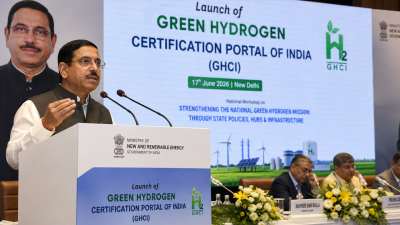
On 17 June 2026 Union Minister Pralhad Joshi launched the Green Hydrogen Certification Portal of India (GHCI) to operationalise the Green Hydrogen Certification Scheme and support the National Green Hydrogen Mission.
GHCI — purpose and administration
- Function: Facilitates transparent certification and regulatory compliance under India’s Green Hydrogen Certification Scheme.
- Developer: Portal developed and hosted by the Ministry of New and Renewable Energy (MNRE).
National Green Hydrogen Mission — targets & funding
- Capacity target: 5 million metric tonnes (MMT) green hydrogen per annum by 2030.
- Renewable support: 125 GW dedicated renewable energy earmarked for the mission.
- Financial outlay: ₹19,744 crore (mission launched 2023).
- Macro estimates: Projected ₹8 lakh crore investment, 6 lakh jobs, and 50 million tonnes annual CO2 abatement.
Policy & industry measures
- State action: Six states notified dedicated policies; seven integrated hydrogen into existing policies; four finalising policies (as of 17 June 2026).
- SIGHT programme: Incentives allocated to create 8,62,000 MTPA green hydrogen production capacity.
- Electrolyser manufacturing: Incentives to 15 firms for 3,000 MW per annum indigenous electrolyser capacity.
- Offtake & pilots: 30,000 MTPA green hydrogen contracts to IOCL, BPCL, HPCL and NRL; 6.7 lakh MTPA green ammonia agreements to 11 fertiliser plants; ₹84 crore for 100% hydrogen injection steel pilots.
- Start-up support: ₹100 crore allocation; nine startups approved for ₹22 crore.
IASPOINT Booster Facts
- Green hydrogen: Produced by water electrolysis using renewable electricity (no fossil feedstock in production).
- Electrolyser types: Alkaline, proton-exchange membrane (PEM), and solid oxide (SOEC).
- Units: MTPA = metric tonnes per annum; MW per annum here denotes annual electrolyser manufacturing capacity.
- Administering ministry: MNRE oversees the National Mission and the GHCI portal.