
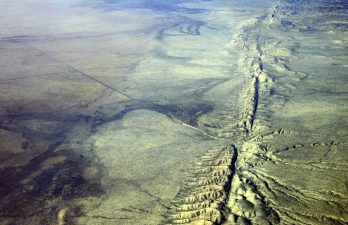
A 3 June 2026 study in Journal of of Geophysical Research: Solid Earth by researchers at the University of Hawaiʻi at Mānoa finds parts of Southern California’s San Andreas and San Jacinto faults are under the highest tectonic stress levels in at least 1,000 years; Cajon Pass is identified as a critical junction for rupture transfer.
Key findings
- Peak stress: Multiple fault segments have reached or exceeded peak values from the past millennium as of 16 June 2026.
- Critical junction: Cajon Pass can either block or facilitate rupture propagation between San Andreas and San Jacinto faults.
- Aligned stress: Stress on several San Andreas and San Jacinto segments is unusually aligned, raising possibility of connected rupture.
- Segments of concern: Mojave South segment (San Andreas) and San Jacinto Bernardino segment recorded peak stresses.
- Historic gap: More than 160 years have passed since a major rupture on key southern San Andreas sections.
- Rupture scenarios: Joint rupture through Cajon Pass could affect Los Angeles, San Bernardino, Riverside and Coachella Valley.
- Timing: Study does not predict when an earthquake will occur; authors call for updated hazard assessments.
- Publication: Published in Journal of Geophysical Research: Solid Earth; lead author from University of Hawaiʻi at Mānoa.
IASPOINT Booster Facts
- Fault type: San Andreas is a right-lateral transform fault marking the Pacific–North American plate boundary (~1,200 km).
- Slip rate: Segment slip rates vary; commonly cited range is ~20–35 mm/yr on major sections.
- Paleoseismic methods: Modelling used 1,000 years of earthquake history with radiocarbon dating and tree‑ring (dendrochronology) data.
- Historic events: 1857 Fort Tejon M7.9 did not propagate through Cajon Pass; 1812 Wrightwood M7.5 may have affected both systems.