
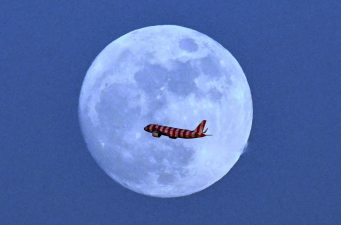
In May 2031, a rare alignment occurs featuring a monthly Blue Moon coinciding with a micromoon on May 31. This is the first monthly Blue Moon since August 2023.
Understanding Lunar Phenomena
- Monthly Blue Moon: The second full moon occurring within a single calendar month. It happens due to the disparity between the lunar cycle (~29.5 days) and the calendar month (30/31 days), recurring roughly every 2.5–3 years.
- Seasonal Blue Moon: The third full moon in an astronomical season containing four full moons.
- Micromoon: A full/new moon coinciding with apogee (the moon’s farthest point from Earth in its elliptical orbit).
Orbital Mechanics: Apogee vs. Perigee
- Apogee: The farthest point from Earth (~405,500 km). Micromoons appear ~14% smaller and ~30% dimmer than supermoons.
- Perigee: The closest point to Earth (~363,300 km). Supermoons create stronger tidal variations (Perigean spring tides).
IASPOINT Booster Facts
- Synodic vs. Anomalistic Month: The synodic month (phases) is 29.53 days, whereas the anomalistic month (orbit distance) is 27.55 days.
- Metonic Cycle: A 19-year cycle wherein lunar phases recur on the same calendar dates.
- Atmospheric Blue Moon: A physical appearance of a blue-tinted moon caused by atmospheric particles (e.g., volcanic ash/forest fires) scattering red light.
- Double Blue Moons: Occur when a year features two Blue Moons (in January and March) due to a “Black Moon” (February without a full moon). Next: 2037.
- Tidal Influence: Micromoons result in reduced tidal ranges (Apogean neap tides).