
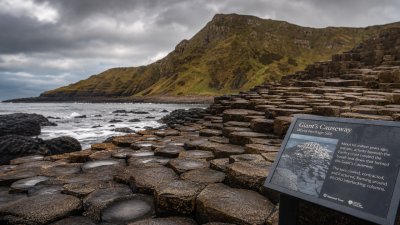
New research by the British Geological Survey and Geological Survey of Northern Ireland (published 14–15 June 2026) shows the Giant’s Causeway volcanic rocks formed in 5.5 million years—8 million years shorter than earlier estimates—and are part of the North Atlantic Igneous Province.
Geological summary
- Location: County Antrim, Northern Ireland; UNESCO World Heritage Site (inscribed 1986).
- Age: ~60 million years ago (Paleocene–Eocene) within the North Atlantic Igneous Province (NAIP).
- Rock type: Basaltic lava flows forming interlocking columnar basalt (~40,000 columns).
Revised timeline
- New duration: 5.5 million years for the volcanic episodes that created the Causeway (research published 14–15 June 2026).
- Previous estimate: ~13.5 million years (new figure is 8 million years shorter).
Formation mechanism
- Thick basaltic lava rose through crustal fractures and erupted as extensive flows.
- Cooling contraction produced columnar jointing—systematic fracturing that yields predominantly hexagonal, interlocking columns.
Regional linkages
- Part of NAIP; correlated formations include Fingal’s Cave (Staffa), Mull, Rùm, Skye, the Mourne Mountains, Greenland and the Faroe Islands.
IASPOINT Booster Facts
- NAIP: A Large Igneous Province (LIP) representing brief, voluminous magmatism at the Paleocene–Eocene boundary.
- Columnar jointing: A cooling contraction phenomenon typical of basaltic lavas; column size relates to cooling rate.