
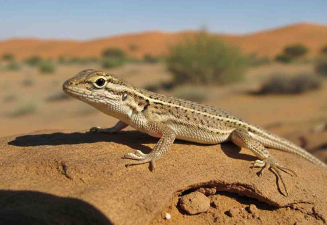
In June 2026, scientists from the Zoological Survey of India (ZSI) identified a new lizard species, Mesalina bishnoi, in the Gajner area of Bikaner, Rajasthan. Collected in August 2025 from a semi-desert habitat, this discovery marks the first specimen-backed, confirmed record of the genus Mesalina in India, resolving a taxonomic gap dating back to 1935. The species is named in honor of the Bishnoi community for their long-standing commitment to environmental conservation.
Morphological and Ecological Features
- Taxonomy: Belongs to the Lacertidae family (Old World lizards). Part of the Mesalina watsonana species complex.
- Physical Traits: A small-bodied reptile with a snout-vent length of 39.2 mm. Features include a greyish to olive-brown dorsal color, distinct dorsolateral stripes, and a mottled pattern of dark brown/black blotches with white spots.
- Diagnostic Markers: Characterized by eight longitudinal rows of ventral plates and five scales on the lower eyelid (two large transparent shields and three smaller ones).
- Habitat: Diurnal and highly adapted to the arid, hard, rocky-soil environment of the Thar desert. Currently considered endemic to the Thar biogeographic province.
IASPOINT Booster Facts
- Zoological Survey of India (ZSI): Established in 1916 under the Ministry of Environment, Forest and Climate Change; headquartered in Kolkata.
- Lacertidae Family: Characterized by well-developed limbs and tail autotomy (ability to shed tails to escape predators).
- Bishnoi Conservation: The community follows 29 tenets set by Guru Jambheshwar (15th century); renowned for the 1730 Khejarli massacre to protect Khejri trees.
- Species Confirmation: Modern identification uses a combination of morphological scale matrices and mitochondrial DNA analysis (e.g., cytochrome b or 16S rRNA genes).