
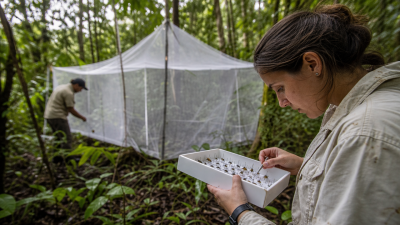
A PNAS study (29 June 2026) estimates global insect species at 14.2–20.3 million, based on intensive sampling in Costa Rica’s Área de Conservación Guanacaste (ACG).
Key findings
- Global estimate: 14.2–20.3 million insect species, versus the long-standing ~6 million estimate.
- Formally described: ~1.2 million insect species named; up to ~95% remain undescribed.
- ACG survey: ACG area = 169,000 hectares; intensive sampling yielded ~53,945 insect species from 15 core Malaise traps and >1.6 million specimens.
- Projected ACG diversity: ~332,846–333,000 insect species estimated for ACG, including ~2,400 Microgastrinae wasp species.
- Focal taxon — Microgastrinae: A hyperdiverse subfamily of Braconidae parasitoid wasps that develop inside lepidopteran caterpillars; used as a biodiversity “yardstick”.
- Methods: 15 Malaise traps (tent-like interception nets) + DNA barcoding for specimen-level delimitation; barcoding commonly targets the mitochondrial COI gene.
- Scaling approach: Researchers scaled local insect richness to global totals using tree-species ratios (ACG 1,200–1,500 trees; global ~73,000) and comparative data from mammals, amphibians and Saturniidae moths.
IASPOINT Booster Facts
- Publication: Proceedings of the National Academy of Sciences (PNAS), 29 June 2026.
- ACG status: Área de Conservación Guanacaste is a recognised biodiversity reserve in northwestern Costa Rica.