
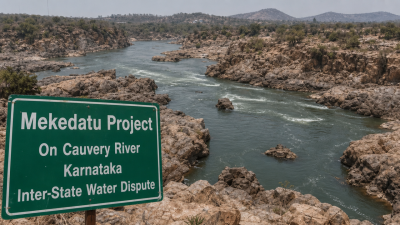
Recently the Tamil Nadu Assembly unanimously passed a resolution opposing Karnataka’s proposed ₹9,000 crore Mekedatu balancing reservoir on the Cauvery. Tamil Nadu asked the Union government to deny clearances, sought a new tribunal under Section 4 of the ISRWDA, and urged the CWC not to process Karnataka’s DPR.
What is the current issue?
- State positions: Tamil Nadu objects to Mekedatu, arguing the Cauvery basin is deficit and fully apportioned; it urged the Centre to withhold technical and environmental clearances. Karnataka maintains the project uses only its allotted share and is primarily for Bengaluru’s drinking water (≈4.75 TMC) and power generation (≈400 MW).
- Political moves: Tamil Nadu moved a unanimous Assembly resolution. Karnataka’s leadership offered dialogue between Chief Ministers. Karnataka has instructed identification of 12,600 acres for compensatory afforestation to offset about 5,100 ha of forest to be submerged.
- Judicial/administrative status: The Supreme Court dismissed Tamil Nadu’s review petition as “premature” while the project remained at DPR stage under Central scrutiny. The CWC’s processing of the DPR is contested politically.
Why this matters for governance and society
- Water security: Urban drinking water needs of Bengaluru versus downstream irrigation and agrarian livelihoods in Tamil Nadu.
- Federal relations: The dispute tests mechanisms of cooperative federalism and state concurrence for projects affecting shared basins.
- Environment and land use: Large-scale forest submergence, biodiversity loss risks, and obligations for compensatory afforestation.
- Administrative process: DPR appraisal, CWC role, central clearances and possible tribunal formation affect project timelines and legal certainty.
Legal and constitutional framework
Core provisions
- Article 262: Empowers Parliament to legislate for adjudication of inter‑state river disputes and permits exclusion of ordinary courts from such disputes.
- Inter-State River Water Disputes Act, 1956 (ISRWDA): Section 4 allows the Union government to constitute a tribunal when negotiations fail. Tribunal awards, once published, are binding and possess the same legal force as a Supreme Court order.
- Judicial role: The Supreme Court has adjudicated aspects of the Cauvery dispute and can be approached for questions of law, enforcement and review in appropriate circumstances; it recently declined premature review while DPR was under Central scrutiny.
Administrative aspects
- Central Water Commission (CWC): Technical appraisal body for water projects; its processing of a DPR can be a focal administrative step that states may seek to influence.
- Clearance regime: Technical clearance, environmental clearance and forest clearances are required under separate central statutes and rules. These run in parallel with inter‑state dispute processes.
Stakeholders and positions
| Stakeholder | Position / Role |
|---|---|
| Tamil Nadu | Opposes Mekedatu; asserts basin is deficit and fully apportioned; seeks denial of clearances and a new tribunal under Section 4 of ISRWDA. |
| Karnataka | Advocates Mekedatu as a balancing reservoir for Bengaluru drinking water (~4.75 TMC) and power (~400 MW); says it will use only its allotted share and benefit farmers. |
| Union Government | Responsible for constituting tribunals, granting technical and environmental clearances, and resolving inter-state disputes administratively or via tribunals. |
| CWC / Ministry of Jal Shakti | CWC provides technical assessment of DPRs; Ministry processes statutory approvals and recommends tribunal constitution when required. |
| Supreme Court | Can adjudicate legal questions, supervise enforcement and review tribunal awards where legally permissible; has treated some petitions as premature while administrative processes continue. |
Environmental and socio-economic implications
- Land and forests: Projected submergence of ~5,100 hectares of forest. Karnataka has ordered identification of ~12,600 acres for compensatory afforestation; implementation and ecological equivalence remain open issues.
- Biodiversity and river ecology: Reservoir creation alters river flow regime, affects riparian habitats and fish migration, and may change sediment transport downstream.
- Socio-economic trade-offs: Benefits: Bengaluru’s drinking water security and ~400 MW hydro-power; possible regulated releases. Risks: Reduced downstream flows impacting irrigation, cropping patterns and rural incomes in Tamil Nadu’s deficit basin.
- Equity questions: Project proponents claim use of Karnataka’s share; opponents argue that basin-wide allocation and prior tribunal awards preclude additional impoundments without concurrence.
Dispute resolution: practice and problems
- Tribunal formation: Section 4 tribunal remains the statutory route when states cannot agree. Political pressure and delays often prevent timely constitution.
- Adjudication vs administrative scrutiny: Projects proceed through DPR and statutory clearances while legal claims persist, producing overlap and litigation over justiciability and timing.
- Time and finality: Tribunal processes and judicial review can be protracted. The Supreme Court’s refusal to entertain premature challenges illustrates procedural sequencing tensions.
- Interim measures: Lack of predictable interim arrangements can exacerbate mistrust and cause unilateral steps by states.
Way forward: institutional and policy reforms
- Integrated basin management: Constitute permanent basin boards with representation of all riparian states, central agencies and expert panels to assess projects, flows and allocation in a basin-wide perspective.
- Transparent data sharing: Mandate real‑time sharing of hydrological data, release schedules and DPR inputs via a central portal to reduce information asymmetry.
- Clear approval rules: Define criteria for permitting new impoundments in adjudicated deficit basins, including requirement of basin concurrence or a fast‑track central adjudication.
- Time-bound adjudication: Statutory timelines for tribunal constitution and disposal. Capacity enhancement for tribunals and a specialised bench mechanism in the Supreme Court for inter‑state water matters.
- Environmental safeguards: Enforce credible compensatory afforestation, independent ecological impact assessment, and binding post‑project monitoring linked to clearances.
- Alternate solutions: Prioritise non-structural measures—demand management, urban water recycling, groundwater recharge and interstate negotiated transfer agreements—before new dams are authorised.
- Dialogue and mediation: Use facilitated bilateral talks and third‑party mediation to build trust and negotiate interim release protocols while legal processes continue.
Model Questions
- Analyse the constitutional and legal framework governing inter‑state river water disputes in India. How does the Mekedatu controversy illustrate gaps in this framework? [GS-II: Constitution of India & Polity]
- “Inter‑state river water disputes often become flashpoints in Indian federalism.” Critically examine this statement with reference to the Mekedatu project and suggest institutional reforms to foster cooperative federalism in water management. [GS-II: Governance]
- Evaluate the environmental and socio‑economic considerations involved in large reservoir projects using Mekedatu as a case study. How should policymakers balance development and ecological protection? [GS-III: Environment & DM]
- Assess the efficacy of existing dispute resolution mechanisms for inter‑state river conflicts. How can the Mekedatu dispute inform reforms for faster and fairer adjudication? [GS-II: Governance]
The answer should outline Article 262, the ISRWDA (Section 4 tribunal mechanism), legal status of tribunal awards, and the Supreme Court’s role. Apply these to Mekedatu: DPR-stage litigation, calls for a new tribunal, overlapping administrative clearances and delays. Recommend clearer sequencing, timelines and central adjudication norms.
Cover competing state priorities (urban water vs downstream irrigation), political signalling (Assembly resolutions), trust deficit, and administrative centrality. Propose permanent basin boards, mandated data sharing, binding interim protocols, and structured CM‑level dialogue backed by technical arbitration.
Include forest submergence (~5,100 ha), compensatory afforestation (12,600 acres), biodiversity and river ecology impacts, urban drinking water (≈4.75 TMC) and power benefits (~400 MW), and downstream agrarian risks. Recommend rigorous EIA, independent monitoring, alternative demand management and strict afforestation compliance.
Discuss tribunal delays, overlapping administrative processes (DPR and clearances), Supreme Court’s procedural stance (premature hearing), and absence of time‑bound protocols. Recommend statutory timelines, specialised benches, interim flow arrangements, and enhanced tribunal capacity for expedited decisions.