
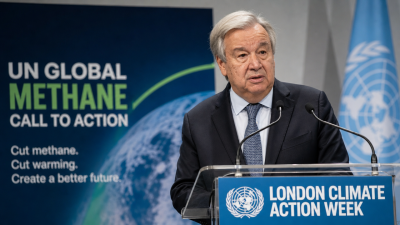
Recently, UN Secretary‑General António Guterres launched a global Call to Action on Methane during London Climate Action Week and warned of twin climate and energy crises driven by fossil‑fuel dependence. The Call targets methane from waste, agriculture and fossil‑fuel operations and accompanies strengthened monitoring and proposals on taxing fossil‑fuel windfalls.
What is the current issue?
Methane causes roughly one‑third of present warming and is about 80 times more potent than CO2 over short timeframes. Rapid methane cuts can produce visible temperature relief within a generation. The UN Call to Action seeks deep cuts in waste, agriculture and oil & gas emissions and urges a new global standard for near‑zero methane across the oil and gas value chain.
Why it matters for governance, economy, security and diplomacy
- Governance: Requires regulatory standards, MRV systems and enforcement across sectors and jurisdictions.
- Economy: Low‑cost mitigation in oil and gas can deliver economic gains; taxing windfall profits can mobilise revenues for transition and social support.
- Energy security: Reducing flaring and leaks increases usable gas supply and reduces volatility.
- International relations: Standards and finance involve negotiated obligations, technology transfer and differentiated responsibilities.
- Environment & society: Faster near‑term climate benefits reduce risks to agriculture, health and ecosystems; avoids crossing tipping points in critical Earth systems.
Understanding the twin climate and energy crises
Continued fossil‑fuel dependence drives both rising greenhouse gas concentrations and recurrent energy shocks. Price spikes have produced windfall profits for some producers while vulnerable populations face higher energy costs. Policy responses therefore combine emissions targets with measures to secure affordable, reliable clean energy and social protection.
Significance of methane as a greenhouse gas
- Potency: ~80× CO2 on short timescales; responsible for ~one‑third of current warming.
- Short‑term leverage: Aggressive methane reductions yield rapid temperature relief, buying time for CO2 mitigation.
- Sectors: Waste (landfills, wastewater), agriculture (enteric fermentation, paddy fields), and fossil fuels (leaks, venting, flaring).
UN Global Call to Action on Methane: objectives and targets
The Call requests producer and consumer governments to adopt a global oil and gas standard targeting near‑zero methane across the value chain. It prioritises three sectors: waste, agriculture and fossil fuel operations. Complementary aims include scaled monitoring, rapid leak response and mobilising finance and capacity for deployment of existing mitigation technologies.
Sources, mitigation potential and data points
| Source | Emission drivers / scale | Mitigation options |
|---|---|---|
| Oil & gas | Leaks, venting, flaring; ~70% of emissions eliminable with current tech | LDAR (leak detection & repair), vapor recovery, end flaring, equipment upgrades |
| Waste | Landfills, wastewater; large local hotspots | Landfill gas capture, biomethanation, organic waste diversion, composting |
| Agriculture | Enteric fermentation, rice paddies, manure management | Improved feed, manure treatment, intermittent irrigation, vaccine/research options |
Data points: About 70% of oil & gas methane emissions can be removed using existing technologies. In 2025, roughly 167 billion m3 of gas were flared globally—equivalent to Africa’s annual gas consumption. The eight largest fossil‑fuel firms reportedly earned an extra USD 6.5 billion in Q1 2026.
Technologies and monitoring: IMEO and MARS
Remote sensing, aircraft and facility‑level sensors form a layered detection approach. The International Methane Emissions Observatory (IMEO) aggregates data; the Methane Alert and Response System (MARS) issues alerts for large plumes and coordinates response. UNEP and Bloomberg are scaling support to reach an 80% response rate to major leaks by 2030. Stronger MRV enables targeted, time‑bound mitigation.
Climate tipping points and scientific implications
A UN Scientific Advisory Board report warned that crossing thresholds in coral reefs, ice sheets, ocean circulation and the Amazon could trigger abrupt and largely irreversible change. Rapid methane reductions reduce peak warming and therefore lower the probability of triggering some tipping elements, while improved monitoring shortens the time between detection and mitigation.
Economic and financial dimensions
- Windfall taxation: Proposal to tax unexpected fossil‑fuel gains to finance social protection and clean energy investment.
- Cost‑effectiveness: Many methane abatement measures in oil & gas are low or no net cost; distributed sectors require finance support.
- Climate finance: International grants, concessional loans and private capital will be needed to scale infrastructure in developing countries.
Challenges to methane reduction
- Technical: Retrofitting legacy infrastructure, ensuring sensor coverage and maintenance.
- Financial: Upfront costs for waste and agricultural interventions; limited access to concessional finance.
- Policy and regulation: Absence of uniform global standards, weak enforcement and fragmented jurisdictional authority.
- Sectoral diversity: Heterogeneous solutions needed for dispersed agricultural sources versus large industrial emitters.
- Capacity: Limited institutional capacity for rapid response to alerts and MRV in many countries.
India: sources, policy and technological interventions
Major source profile
India’s methane emissions arise mainly from paddy rice, enteric fermentation in livestock, municipal solid waste and leaks/flaring in the fossil‑fuel value chain.
Policy and regulatory measures
- Agriculture: Promote alternate wetting and drying in rice, improved animal feed, adoption of anaerobic digesters for manure, extension services and result‑based incentives.
- Waste management: Expand biomethanation and waste‑to‑energy facilities, mandate landfill gas capture, enforce segregation and composting norms.
- Fossil‑fuel sector: Mandate LDAR programmes, prohibit routine flaring, require near‑zero methane targets for new projects and tighter equipment standards.
- Finance and incentives: Use green bonds, targeted subsidies, risk guarantees and access to international climate funds for scaling technologies.
- MRV and institutions: Integrate national monitoring with IMEO, strengthen field response capacity, and establish clear reporting protocols.
International cooperation and governance
- Global standard: Negotiation of an oil & gas near‑zero methane standard requires common definitions, measurement protocols and enforcement pathways.
- Technology transfer: Concessional finance and technical assistance for developing countries to deploy low‑cost technologies.
- Market and trade measures: Procurement standards, methane‑sensitive supply chain rules and conditional finance can drive compliance.
- Multilateral platforms: Use COP31, UNEP, IMEO and bilateral channels to align targets, finance and MRV practices.
Model Questions
1. Discuss the role of methane emission reduction in meeting short‑term climate goals and evaluate the feasibility of the UN Global Call to Action on Methane for developing countries. [GS-III: Environment & DM]
Rapid methane cuts yield measurable temperature relief within a generation because methane is ~80× more potent than CO2 and causes about one‑third of warming. The Call targets waste, agriculture and oil & gas, and seeks near‑zero oil & gas emissions. Feasibility for developing countries depends on access to finance, technology transfer, capacity building, tailored timelines and strengthened MRV. International concessional finance and targeted technical assistance are essential.
2. Analyse the rationale and implications of taxing fossil‑fuel companies’ windfall profits to support a just energy transition and the establishment of a global oil and gas methane standard. [GS-II: Governance]
Taxing windfall gains channels revenues to protect vulnerable households and to finance clean energy. It addresses inequities from fossil‑fuel shocks and creates fiscal space for transition. Establishing a global methane standard requires harmonised measurement, enforcement and dispute mechanisms; it will face industry resistance and geopolitical negotiation. Domestic legal frameworks must ensure transparent revenue use and align with international commitments.
3. Explain the scientific concept of climate tipping points and assess how monitoring systems like IMEO and MARS can change mitigation responses to methane emissions. [GS-III: Science & Technology]
Tipping points are thresholds where gradual forcing triggers abrupt, often irreversible, changes in systems such as ice sheets, coral reefs, ocean circulation and the Amazon. IMEO and MARS improve detection of large methane plumes and enable rapid response, prioritising mitigation where it reduces near‑term warming most. Enhanced MRV supports evidence‑based policy, though response capacity and coverage gaps must be addressed to convert alerts into action.
4. Given India’s development priorities, recommend specific policy, technological and institutional measures the country should prioritise to reduce methane emissions across agriculture, waste and the energy sector. [GS-III: Environment & DM]
Prioritise alternate wetting and drying and improved feed in agriculture; scale biomethanation, landfill gas capture and segregation in waste; mandate LDAR, ban routine flaring and set near‑zero targets in energy. Mobilise finance via green bonds and international funds, invest in R&D and farmer extension, strengthen MRV tied to IMEO, and phase measures with clear timelines to reconcile development and mitigation objectives.
Last Modified: June 24, 2026