
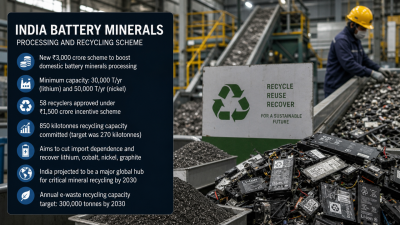
As of 23 June 2026 the Ministry of Mines is finalising a ₹3,000 crore battery minerals processing scheme expected to be approved within three months; 58 recyclers have been approved under an existing ₹1,500 crore recycling incentive scheme.
Proposed processing scheme
- Budget and timeline: ₹3,000 crore outlay; approval anticipated within three months (from 23 June 2026).
- Minimum capacities: Lithium processing plants ≥30,000 metric tonnes per year; nickel plants ≥50,000 metric tonnes per year.
- Primary objective: Build domestic processing value chain for lithium and nickel to reduce import dependence.
Critical Mineral Recycling Incentive Scheme — status
- Scheme size and approvals: ₹1,500 crore; 58 recyclers approved as of 23 June 2026.
- Committed capacity: 850 kilotonnes of recycling capacity committed versus initial target of 270 kilotonnes.
- Target materials and feedstock: Recovery of lithium, cobalt, nickel, graphite from end‑of‑life batteries, e‑waste and industrial scrap.
- 2030 projection: ~300,000 tonnes annual e‑waste recycling capacity envisaged; India projected as a global recycling hub by 2030.
Exploration, mining and value‑chain gaps
- Exploration: Geological Survey completed 571 critical‑mineral projects; goal to exceed 2,000 projects by 2031.
- Mines: 36 mines operationalised in 2025‑26, including 28 greenfield projects.
- Localisation gaps: Dependence on imported semiconductors and rare‑earth magnets; traction motors only ~50–60% localised.
Implementation mechanisms
- Collection system: Pilot framework and a unified digital platform being developed for nationwide collection of end‑of‑life batteries and e‑waste.
IASPOINT Booster Facts
- Administering bodies: National Critical Mineral Mission administers recycling incentives; Ministry of Mines to oversee processing scheme.
- Finance equivalent: ₹3,000 crore ≈ USD 313–317 million (mid‑2026 estimate).