
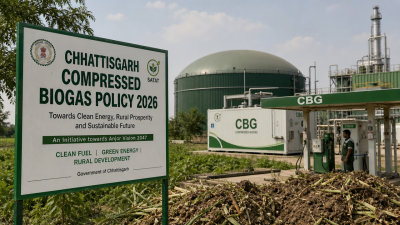
On 23 June 2026 the Chhattisgarh Cabinet approved the Compressed Biogas (CG-CBG) Policy 2026 to convert agricultural residue, cattle dung and organic waste into compressed biogas for use as clean transport fuel.
Key features
- Objective: Convert agricultural residue, municipal solid waste, livestock waste and other organic materials into CBG to support scientific waste management and clean fuel production.
- Nodal agency: Chhattisgarh Biofuel Development Authority designated for implementation; Energy Department authorised to issue operational guidelines.
Resources & target
- Estimated potential: Nearly 5 lakh tonnes of CBG per year from available biomass and organic waste under the Anjor Vision 2047 framework.
- Primary feedstocks: Crop residue, cattle dung, municipal solid waste and other organic wastes.
Implementation & incentives
- Incentive package: Capital support, interest subsidies, infrastructure assistance and facilitation for statutory approvals to attract private investment.
- Central linkage: Policy aligns with the Government of India SATAT programme, supporting CBG as a transportation fuel to reduce fossil fuel reliance.
- Rural outcomes: Expected creation of new income streams for farmers and employment in decentralised CBG value chains.
Technology & innovations
- Biocomposite: ICAR‑IVRI developed a cow-dung–sheep-wool biocomposite for livestock sheds to reduce heat stress and support sustainable livestock production.
IASPOINT Booster Facts
- CBG specification: CBG is biogas upgraded by removing CO2 and impurities to meet compressed natural gas specifications for vehicular use.
- State biofuel bodies: State Biofuel Development Authorities coordinate investors, industry and government agencies for policy execution and central scheme linkage.