
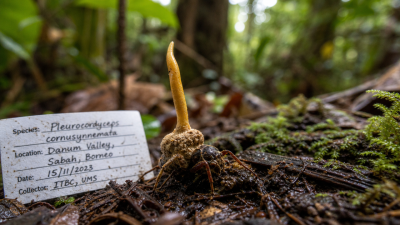
On 19 June 2026 Malaysian scientists announced the discovery of a new hyperparasite fungus, Pleurocordyceps cornusynnemata, in the Danum Valley, Sabah (northern Borneo).
Key features
- Species and taxonomy: Pleurocordyceps cornusynnemata; genus Pleurocordyceps; classified as a hyperparasite (parasite of other fungi).
- Morphology: Exhibits a distinct horn-shaped structure; first known Pleurocordyceps species with this form.
- Host specificity: Parasitises Ophiocordyceps species, the so-called “zombie fungi” that infect ants.
Ecological interaction
- Mode of parasitism: Invades and consumes Ophiocordyceps tissue inside the insect host rather than altering ant nervous system behaviour.
- Trophic role: Functions as a secondary fungal parasite and may influence population dynamics of entomopathogenic fungi.
- Location and habitat: Collected in Danum Valley, a protected lowland rainforest research area in Sabah, Malaysian Borneo.
Research and publication
- Lead institution: University of Malaysia Sabah — Institute for Tropical Biology and Conservation.
- Publication: Species description published in April 2026 in Phytotaxa and the New Zealand Journal of Botany.
- Applied potential: Reported prospects for antimicrobial compound discovery and fungal biocontrol development.
IASPOINT Booster Facts
- Hyperparasite (definition): An organism that parasitises another parasite; in ecological networks it can modify disease transmission.
- Ophiocordyceps (family): Entomopathogenic genus in Ophiocordycipitaceae known for host-specific infection and behavioural effects.
- Danum Valley (status): Long-term ecological monitoring site and protected forest area in eastern Sabah.