
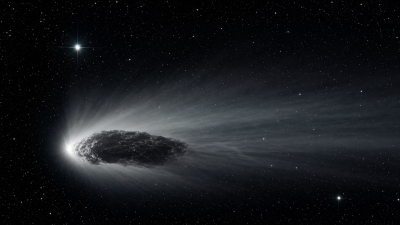
After its December 2025 perihelion, JWST observations of interstellar comet 3I/ATLAS recorded extremely high deuterium and low carbon‑13, enabling chemical analysis of material older than the Solar System.
Key chemical signatures
- Deuterium (D): JWST/NIRSpec measured deuterium levels ~30× those in typical Solar System comets.
- Carbon isotopes: Very low 13C/12C ratio compared with Solar System material; consistent with formation in a very old stellar environment.
- Methanol richness: ALMA measured CH3OH/HCN ratios ≈ 70–120, much higher than usual cometary values.
Formation environment & age
- Formation temperature: Extremely high D requires synthesis in very cold conditions (dense, frozen molecular cloud chemistry).
- Age estimate: Chemical pattern consistent with formation 10–12 billion years ago, predating the Sun.
Observations & methods
- Instruments: JWST NIRSpec (near‑IR spectroscopy), ALMA (mm/submm molecular lines), ESO VLT (optical/IR spectroscopy).
- Timing & publication: JWST and VLT observations made in December 2025 after perihelion; results published in Nature (22–23 June 2026).
- Target advantage: Freshly warmed ancient ices produced a bright coma enabling remote isotopic and molecular measurements.
IASPOINT Booster Facts
- Interstellar comets: 3I/ATLAS is the third confirmed interstellar comet after 1I/’Oumuamua and 2I/Borisov.
- Deuterium utility: D/H ratios act as a thermometer for formation conditions in ices and organics.
- Carbon isotopes: 13C/12C ratios trace stellar nucleosynthesis and galactic chemical evolution.
- ALMA vs JWST: ALMA traces cold gas molecules; JWST NIRSpec detects vibrational/rotational features of ices and organics.