
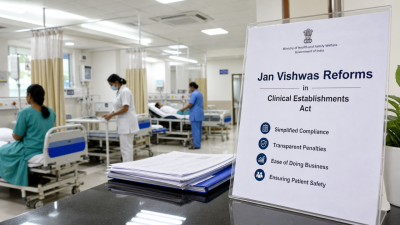
The Union Ministry of Health and Family Welfare notified amendments to the Clinical Establishments (Registration and Regulation) Act, 2010 on 22 June 2026 under the Jan Vishwas (Amendment of Provisions) Act, 2026. The changes decriminalise minor procedural lapses and shift enforcement to administrative adjudication with graded penalties and expanded adjudicating authority.
What is the current change?
Core legal modifications
- Statutory basis: Amendments implemented under the Jan Vishwas (Amendment of Provisions) Act, 2026.
- Terminology: The word “fine” replaced by “penalty” in Sections 40, 43 and 46 of the Clinical Establishments Act.
- Enforcement shift: Movement from criminal prosecution to administrative adjudication for covered contraventions.
- Adjudication scope: Section 41’s adjudicating authority now covers proceedings under Sections 40, 43 and 44.
- Penalty design: Introduction of graded and proportionate penalties, including specific provisions for companies under Section 44.
- Procedure: Structured adjudication with hearings, penalty recovery mechanisms and an appeal framework.
Why this matters for governance and the health sector
- Regulatory burden: Reduces criminal law exposure for hospitals, nursing homes and diagnostic centres.
- Ease of doing business: Predictable, administrative enforcement aims to lower litigation and compliance costs.
- Public interest: Changes must preserve patient safety and quality while making enforcement fairer and faster.
- Policy signal: Part of a wider reform across 79 Central Acts administered by 23 Ministries; 35 provisions in five health-related Acts amended to decriminalise minor procedural non-compliances.
Key provisions: brief legal anatomy
Decriminalisation and penalties
- From fine to penalty: Criminal liability removed for specified minor contraventions; administrative penalties substituted.
- Graded penalties: Scale of penalties tied to nature of contravention and entity type (individual, company, establishment).
- Adjudicating authority: Single authority under Section 41 empowered to conduct hearings, determine penalties, order recovery and receive appeals.
Comparison: Enforcement regime — before and after
| Dimension | Before | After (Jan Vishwas amendments) |
|---|---|---|
| Legal character of sanction | Criminal sanction termed “fine”; possible prosecution | Administrative “penalty”; no criminal prosecution for specified lapses |
| Adjudication forum | Court-based criminal procedure | Designated adjudicating authority under Section 41 with hearings and appeals |
| Penalty design | Uniform fines in statute | Graded and proportionate penalties; special rules for companies |
| Appeals and recovery | Criminal appeal processes; longer timelines | Structured administrative appeal route; mechanisms for penalty recovery |
Implications for patient safety and accountability
- Preservation of severe sanctions: Amendments target minor procedural non-compliances; serious clinical negligence and criminal acts remain subject to stringent action.
- Timeliness: Administrative adjudication can deliver faster resolution and penalty recovery, improving deterrence where financial penalties suffice.
- Risk vectors: Reduced criminal threat may lower deterrence for borderline misconduct unless backed by clear thresholds and robust oversight.
- Accountability instruments: Need for transparent adjudication records, public reporting, patient grievance redressal and linkage with licensing and accreditation (for example, state registry actions, NABH standards).
Institutional and implementation considerations
- Capacity of adjudicating authorities: Require training, standard operating procedures, and IT systems to manage caseloads and appeals.
- Rule-making: Detailed rules to define graded penalties, thresholds distinguishing minor and serious violations, and timelines for hearings.
- Coordination: Alignment with state-level public health regulators, medical councils, and accreditation agencies to avoid regulatory gaps.
- Monitoring metrics: Track compliance rates, complaint volumes, patient outcomes and time-to-resolution to evaluate impact.
- Stakeholder outreach: Awareness drives for clinical establishments and patient groups to explain new processes and preserve trust.
Risks, safeguards and indicators of success
- Risk: Potential dilution of deterrence if administrative penalties are too low or enforcement weak.
- Safeguards: Preserve criminal provisions for serious harm; publish adjudication decisions; periodic independent audits.
- Success indicators: Faster disposal of cases, lower litigation, maintained or improved patient safety indicators, increased voluntary compliance, transparent penalty recovery.
Model Questions
1. Critically analyse the objectives and key provisions of the Jan Vishwas reforms introduced in the Clinical Establishments (Registration and Regulation) Act, 2010. How do these reforms seek to foster ease of doing business while ensuring regulatory efficiency? [GS-II: Governance]
Write a condensed answer in 60-70 words covering all points /dimensions in short. Administrative amendments replace “fine” with “penalty”, move enforcement from criminal prosecution to adjudication, and expand Section 41 to cover Sections 40, 43 and 44. Graded penalties, hearings and appeal mechanisms aim to reduce litigation, lower compliance costs and encourage voluntary compliance. Regulatory efficiency depends on clear penalty scales, empowered adjudicating authorities, coordination with state regulators and safeguards to retain strict action for serious patient-safety violations.
2. Discuss the potential implications of replacing criminal prosecution with administrative adjudication under the Jan Vishwas Act for patient safety and accountability in healthcare. [GS-II: Governance]
Write a condensed answer in 60-70 words covering all points /dimensions in short. Decriminalisation of minor procedural lapses can speed resolution and reduce unnecessary litigation, enabling timely penalties and recovery. Accountability remains through graded sanctions, hearings and appeals. Risks include weaker deterrence if penalties are inadequate or enforcement lax. Mitigation requires clear thresholds separating minor and serious offences, public reporting of adjudications, linkage to licensing/accreditation, and periodic audits to protect patient safety.
3. Examine the broader significance of the Jan Vishwas (Amendment of Provisions) Act, 2026 for regulatory reforms in India, with reference to its impact on the health sector and the Clinical Establishments Act. [GS-II: Governance]
Write a condensed answer in 60-70 words covering all points /dimensions in short. Jan Vishwas rationalises provisions across 79 Central Acts and 23 Ministries to decriminalise minor procedural breaches and promote trust-based governance. In health, 35 provisions across five Acts were amended. The Clinical Establishments Act changes reduce criminal exposure for minor lapses, streamline enforcement and aim to ease business operations. Outcome depends on robust rule-making, institutional capacity and safeguards preserving public-health accountability.
4. To what extent do the recent amendments to the Clinical Establishments Act balance reduction of compliance burden with the need to maintain healthcare quality and patient safety? [GS-II: Governance]
Write a condensed answer in 60-70 words covering all points /dimensions in short. The amendments balance objectives by targeting minor procedural non-compliances for administrative penalties while retaining criminality for serious harm. Structured adjudication, graded penalties and appeals promote fairness and predictability. Effective balance requires precise rules, strong adjudicating capacity, transparent decisions, coordination with licensing and accreditation bodies, and monitoring of clinical outcomes to ensure quality is not compromised by reduced criminal sanctions.
Last Modified: June 26, 2026