
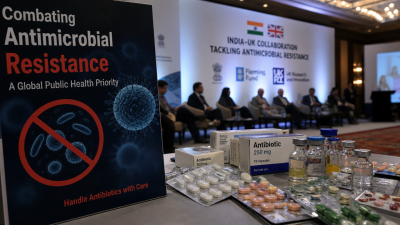
India faces rising antimicrobial resistance (AMR) with common infections increasingly needing second- or third-line drugs. Recent clinical observations, national surveillance and global estimates show high death tolls and multi-sector drivers—human misuse, livestock use, and environmental contamination—creating urgent governance, economic and public‑health challenges.
What is the current issue?
AMR occurs when microbes no longer respond to medicines that previously controlled them. WHO draft guidance reports bacterial AMR caused 1.14 million deaths globally in 2021; India accounts for nearly 300,000 AMR-linked deaths annually. Clinicians note common infections now require stronger antibiotics. India reports widespread inappropriate antibiotic use in primary care and a strong self‑medication culture.
Why this matters for governance, economy and security
- Health system: Increased morbidity, longer hospital stays, higher ICU demand, and failure of standard procedures such as surgery and chemotherapy.
- Economy: Higher treatment costs, lost worker productivity, and fiscal pressure on public health financing.
- National security: Cross‑border spread of resistant pathogens undermines epidemic preparedness and complicates outbreak response.
- Environment: Pharmaceutical effluent and agricultural runoff create reservoirs of resistance.
Major drivers of AMR
- Human misuse: Excessive prescribing for viral illnesses; ICMR 2024 data show ~60% of primary‑care encounters inappropriately involve antibiotics. OTC sale and self‑medication are widespread.
- Animal and agricultural use: Veterinary and agricultural antibiotics represent about three‑quarters of global consumption; routine use for growth promotion and prophylaxis accelerates resistance.
- Environmental contamination: Untreated pharmaceutical effluents and hospital waste release antibiotic residues and resistant bacteria into water bodies.
- Poor infection control and sanitation: Inadequate hygiene in facilities and communities amplifies transmission of resistant strains.
India’s vulnerability and specific challenges
- High burden of resistant infections: Drug‑resistant tuberculosis and rising resistant hospital pathogens make India a high‑risk setting.
- Prescribing and access gaps: Inappropriate prescribing practices, easy OTC access, and self‑medication drive misuse.
- Regulatory and enforcement deficits: Fragmented enforcement across human, veterinary and environmental regulators weakens compliance.
- Awareness gap: Public understanding remains low despite leadership appeals urging antibiotic use only on medical advice.
- Industrial emissions: Pharmaceutical manufacturing clusters release effluents that select for resistance if not treated.
Socio‑economic and clinical consequences
- Mortality and morbidity: Tens of thousands of avoidable deaths annually in India; severe outcomes in neonates and immunocompromised patients.
- Cost escalation: Use of second‑ and third‑line drugs raises direct costs; prolonged care increases indirect costs.
- Impact on development: Threatens gains in maternal and child health, TB control and surgical care.
Policy, regulation and implementation status
- National strategy: India has national AMR action plans aligned to a One Health approach and surveillance through ICMR networks.
- Human sector measures: Guidelines exist for rational prescribing and antimicrobial stewardship in tertiary hospitals; primary‑care stewardship remains weak.
- Veterinary and agricultural regulation: Recent regulatory steps restrict certain antibiotics in livestock and set withdrawal periods for residues.
- Environmental controls: Standards for effluent discharge and proposals for stricter monitoring have been discussed but require stronger enforcement.
- Enforcement gap: Regulation is present but implementation, monitoring and penalties are uneven across states.
International collaboration and support
- WHO Global Action Plan: Global guidance for 2026–2036 frames surveillance, R&D, stewardship and financing priorities.
- UK‑India partnerships: UK Research and Innovation committed over £10 million and the Fleming Fund contributed ~£600,000 for research, diagnostics, laboratory strengthening and surveillance in India.
- Public engagement platforms: Collaborative awareness initiatives use storytelling and performance to reach broader audiences.
Pharmaceutical innovation and India’s role
- New antibiotic discovery: Wockhardt UK Ltd launched Zaynich, the first‑in‑class antibiotic from India in nearly three decades; it has treated over 70 patients unresponsive to other antibiotics.
- Market and R&D: Zaynich represents a potential global market exceeding USD 9 billion and signals rising Indian capability in antimicrobial R&D and clinical development.
- Policy implication: Innovation must be accompanied by stewardship, access controls and equitable pricing to avoid rapid loss of efficacy.
One Health: components and operational measures
- Integrated surveillance: Link human, animal and environmental AMR surveillance with standardised data reporting and genomic tracking.
- Responsible prescribing and access control: Enforce prescription‑only antibiotic sales, implement antimicrobial stewardship across primary and tertiary care, and train prescribers.
- Veterinary reforms: Prohibit non‑therapeutic antibiotic use, strengthen veterinary prescription systems, and monitor residues in food chains.
- Environmental safeguards: Mandate effluent treatment standards for pharmaceutical units and hospitals; regular audits and penalties for non‑compliance.
- Infection prevention: Invest in water, sanitation, hygiene (WASH), vaccination and hospital infection control to reduce antibiotic demand.
- Inter‑sectoral governance: Create a central coordinating body with state representation, measurable targets, and dedicated funding.
| Stakeholder | Primary responsibility |
|---|---|
| Ministry of Health | Clinical stewardship, surveillance, public communication |
| Ministry of Fisheries, Animal Husbandry & Dairying | Veterinary regulation, surveillance of antibiotic use in livestock |
| Ministry of Environment | Effluent standards, environmental monitoring |
| State governments | Implementation, inspections, enforcement |
| Industry and pharma | R&D, responsible production, effluent treatment |
| Civic groups and media | Public education, behaviour change campaigns |
Practical priorities and way forward
- Strengthen primary‑care stewardship: Train clinicians, audit prescribing, and incentivise diagnostic use to reduce inappropriate antibiotic prescribing.
- Regulate access: Implement and enforce prescription‑only policies; curb OTC sales and informal antibiotic supply chains.
- Scale surveillance and labs: Expand laboratory capacity and integrate human, animal and environmental data streams.
- Industrial and environmental compliance: Enforce effluent norms for pharmaceutical and healthcare facilities with transparent monitoring.
- Support R&D with stewardship: Fund new drug discovery and diagnostics while protecting new agents through controlled use policies.
- Public engagement: Use mass media, community theatre and leadership messaging to shift norms against self‑medication and to promote adherence to prescriptions.
- Finance and governance: Secure dedicated funding, define measurable targets, and strengthen inter‑ministerial coordination under One Health.
Model Questions
1. Examine the major drivers of antimicrobial resistance, its socio‑economic consequences, and the international mechanisms available to address it. [GS-II: Governance]
AMR drivers include human misuse and OTC access, self‑medication, inappropriate primary‑care prescribing (ICMR: ~60% misuse), extensive veterinary/agricultural use (~75% of global consumption) and environmental contamination from effluents. Consequences: higher mortality, treatment costs, lost productivity, compromised surgeries and TB control. International mechanisms: WHO Global Action Plan, bilateral research funding, and global surveillance collaborations. Governance needs integrated stewardship, enforcement, surveillance and sustainable finance.
2. Assess why India is described as ‘ground zero’ for AMR and evaluate the effectiveness of domestic policy responses. [GS-II: Governance]
India’s high AMR burden stems from dense population, high infectious disease load, self‑medication culture, weak primary‑care stewardship and pharmaceutical effluent risks. Policies exist—national AMR action plan, stewardship guidelines, veterinary restrictions—but implementation gaps persist: uneven enforcement, inadequate lab capacity and limited behaviour change. Effectiveness requires stronger state enforcement, scaled surveillance, stricter sales controls and investment in primary‑care diagnostics and public awareness.
3. Analyse the role of pharmaceutical innovation and collaborative research in combating AMR, with reference to recent Indian developments. [GS-III: Science & Technology]
New antibiotics and diagnostics reduce reliance on existing classes and restore treatment options. Indian innovation example: Zaynich by Wockhardt UK Ltd—first‑in‑class Indian breakthrough in decades—has treated >70 refractory patients and indicates a USD 9 billion market opportunity. Collaborative research funding (UK Research and Innovation, Fleming Fund) supports R&D, diagnostics and lab strengthening. Policy must balance innovation incentives with stewardship and equitable access.
4. Discuss the components of a One Health approach to curb AMR in India, emphasising regulatory and environmental measures. [GS-III: Environment & DM]
One Health combines human, animal and environmental actions: integrated surveillance, prescription‑only antibiotic sales, veterinary bans on non‑therapeutic use, residue monitoring, mandatory effluent treatment for pharma and hospitals, and WASH and infection control to reduce demand. Regulation requires clear standards, state enforcement, inter‑ministerial coordination, funding for laboratories and public communication to change prescribing and consumer behaviour.
Last Modified: June 29, 2026