
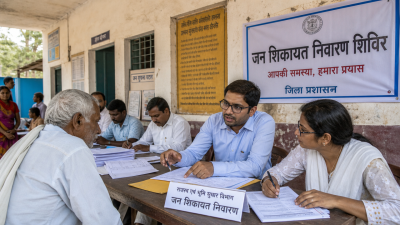
Recently Vivek Kumar Singh argued for a district-level Land Grievance Triage Protocol to prevent land complaints from monopolising public grievance forums and to ensure grievances are routed to legally competent bodies for actual resolution rather than mere disposal.
What is the problem and why it matters
Land grievances form a large share of petitions in public grievance forums. Many forums lack the legal authority to decide complex land disputes. Result: repeated petitions, citizen frustration, erosion of trust in the State, and administrative time spent without clear outcomes. The issue affects governance, property markets, rural development, social harmony and public confidence in institutions.
Concept and objective of the Land Grievance Triage Protocol
Core concept: convert public grievance bodies into “intelligent gateways” that classify, assess and route land complaints to the correct statutory or judicial pathway. Primary objective: shift performance metrics from numbers “disposed” to grievances correctly routed and progressing towards final resolution.
Basic process
- Registration: Capture facts, claimant identity, key documents and statutory flags on a standard form.
- Classification: Assign grievance to a predefined category (e.g. encroachment, possession dispute, title claim, revenue record error, pending court case).
- Assessment: Use a simple matrix to evaluate urgency, conflict potential, legal complexity and existence of parallel proceedings.
- Routing: Issue a formal referral to the designated authority with timeline and expected next steps; where necessary, list documents required for acceptance by the receiving authority.
- Tracking: Maintain digital case-tracking and feedback loop until the matter reaches a competent forum or closure.
Key features and components
- Standard classification taxonomy: Uniform grievance types and referral codes for district use.
- Assessment matrix: Scoring for urgency, displacement risk, revenue/judicial overlap and social tension potential.
- Designated referral pathways: Clear mapping from grievance type to authority (revenue office, civil court, land tribunal, specialized state schemes).
- Legal mandate for triage centres: Statutory or administrative order authorising classification, referral and information-sharing.
- Digital backbone: Single-window portal, unique grievance IDs, inter-agency workflow and dashboards for performance metrics.
- Capacity building: Training modules for staff, standard operating procedures and escalation rules.
- Citizen interface: Information on expected pathway, documents required and timelines; grievance acknowledgement that specifies the routed authority.
Classification table (sample)
| Grievance type | Triage action | Designated pathway (examples) |
|---|---|---|
| Encroachment on public land | Refer to revenue officer; immediate on-ground verification if displacement risk | Revenue department action; eviction orders under revenue law; local administration for temporary relief |
| Possession dispute between neighbours | Assess for civil suit or local mediation; avoid forum deciding title | Civil court / mediation centre / land tribunal where statute exists |
| Family partition and succession claim | Refer to civil courts; note any urgent tenancy or occupation issues for interim relief | Civil court; family mediation panels for non-title aspects |
| Discrepancy in land records | Route to revenue record correction mechanism; flag for survey update | Sub-registrar/revenue records section; state land record modernisation programmes |
| Pending court matter | Mark as sub-judice; provide status summary; no routing | Maintain record; liaise with litigant about court process |
Benefits and expected outcomes
- Administrative efficiency: Saves time by preventing non-competent disposal attempts and reducing repeat petitions.
- Higher resolution rates: More grievances reach competent forums quickly, increasing chances of final settlement.
- Restored trust: Citizens receive clear information and tracked referrals, reducing perception of arbitrariness.
- Conflict reduction: Early risk scoring enables prioritisation of high-tension cases and preventive action.
- Policy clarity: Clear role statements reduce jurisdictional overlap between revenue, police and courts.
Institutional and administrative challenges
- Divergent state laws: Land law and dispute resolution mechanisms vary across states; a uniform national protocol must allow adaptations.
- Legal authority: Triage centres need statutory or administrative backing to collect and share records and to issue formal referrals.
- Capacity gaps: Shortage of trained personnel skilled in legal classification and conflict assessment at district level.
- Inter-agency coordination: Need for memorandum of understanding between revenue, judiciary, police, urban local bodies and specialised tribunals.
- Data quality: Incomplete land records and poor digitisation undermine correct classification and routing.
- Resistance to change: Administrative inertia and vested interests may resist reallocation of cases and transparent tracking.
- Resource needs: Funding for IT systems, staffing, training and outreach.
Implementation framework — practical steps
- Model protocol: Centre issues a model triage protocol that states may adopt and adapt to local law.
- Legal instrument: States give triage centres authority through rules or notification to allow record-sharing and referrals.
- Pilot districts: Start with selected districts representing urban-rural and land-law diversity; evaluate and scale.
- Capacity plan: Training for triage officers, legal advisors and community outreach staff; standard operating procedures.
- IT platform: Interoperable grievance portal integrated with land records (SR, BhuNaksha), court status and revenue workflows.
- Performance metrics: Measure correct routing rate, time-to-intake by designated authority, final resolution rate and citizen satisfaction.
- Public information: Clear Guidance Notes for citizens on what to expect and how to follow referrals.
- Escalation and audit: Periodic audits of routing decisions and grievance outcomes; grievance ombudsman for process lapses.
Bihar model — what to use and what to adapt
Bihar operates a time-bound public grievance redressal system and a specialised mechanism under the Bihar Land Disputes Resolution Act. These statutory arrangements can be used as practical templates for referral pathways, time-bound targets and dedicated adjudicatory bodies. States should adopt procedural features (time limits, specialised benches, evidence-handling rules) while preserving each state’s substantive land law.
Performance measurement and citizen safeguards
- Outcome-oriented KPIs: Correct routing percentage, referral acceptance rate, mean time to competent intake, final settlement rate.
- Transparency: Public dashboards and grievance histories accessible to claimants.
- Safeguards: No preclusion of judicial remedy; triage must not substitute adjudication where law requires court determination.
- Legal redress for process failures: Right of appeal within the administrative framework for misrouted grievances.
Model Questions
1. Examine how a Land Grievance Triage Protocol can transform public grievance redressal by shifting focus from disposal to effective resolution. [GS-II: Governance]
The protocol makes grievance forums act as classification and routing centres, not adjudicators. Key measures: standard taxonomy, assessment matrix, formal referral pathways and tracking. Benefits include faster access to competent forums, reduced repeat petitions, clearer roles for revenue/court bodies and improved citizen trust. Success requires legal mandate for triage, digital tracking and KPIs that measure routing accuracy and resolution rates rather than simple disposal counts.
2. Discuss the institutional and administrative challenges in implementing a uniform Land Grievance Triage Protocol across districts and suggest a practical framework. [GS-II: Governance]
Challenges: diverse state land laws, need for statutory backing, capacity shortages, inter-agency coordination, poor land records and resistance to change. Framework: Centre provides a model protocol; states adapt via notification; pilot districts; legal authority for triage; interoperable IT platform; training programme; MOUs among agencies; KPIs focused on routing accuracy and resolution. Public information and audits ensure accountability.
3. Unresolved land grievances erode public trust and worsen socio-economic inequality. Evaluate whether a triage protocol can mitigate these effects. [GS-II: Social Justice]
By directing grievances promptly to competent bodies and prioritising urgent social-impact cases, triage reduces delays that cause livelihood loss and tenure insecurity. Faster correction of records supports land markets and inclusive development. Early risk-scoring prevents escalation into violent conflict. Combined with outreach and legal aid, triage can improve access to justice and reduce inequality produced by protracted land disputes.
4. Assess the utility of using state models such as Bihar’s land dispute mechanism in designing a national triage protocol and its implications for cooperative federalism. [GS-II: Governance]
State models provide tested referral pathways, time-bound targets and specialised benches that can be adapted. Utility: operational practices, evidence rules and timelines. For cooperative federalism: central model guidance with state-specific adaptations preserves autonomy while promoting standards. Implementation needs consultation, incentives for adoption, and flexibility to align with local land statutes and administrative structures.
Last Modified: June 29, 2026