
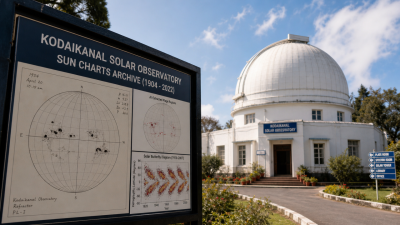
On 1 July 2026 scientists announced an AI-based analysis of Kodaikanal Solar Observatory (KoSO) hand-drawn suncharts, producing a digitised record of solar magnetic activity spanning 1916–2007.
Key study facts
- Period analysed: Plages traced across nine solar cycles, Solar Cycles 15–23 (1916–2007).
- Source archive: KoSO daily suncharts (1904–2022) containing sunspots, plages, filaments and prominences on a standard grid.
- Method: Supervised U-Net convolutional neural network for image segmentation, adapted to variable drawing styles and degraded paper scans.
- Output products: Digitised plage catalogue and a butterfly diagram mapping latitudinal migration of magnetic activity over time.
- Validation: Reconstructed measurements closely matched KoSO Ca II K full-disk observations.
- Publication and collaboration: Paper in The Astrophysical Journal; collaborators include ARIES (DST), IIST, IIA and Southwest Research Institute (USA).
- Space‑weather relevance: Long-term plage records inform studies of solar magnetic variability that affect satellites, navigation, communication and power systems.
IASPOINT Booster Facts
- Plage definition: Bright chromospheric regions seen in Ca II K (393.4 nm), associated with concentrated magnetic fields.
- Butterfly diagram: Plots sunspot/plage latitude vs time; shows equatorward drift during a solar cycle.
- U-Net: Encoder–decoder CNN architecture widely used for biomedical and remote‑sensing image segmentation.
- ARIES: Autonomous institute under Department of Science and Technology (DST) that maintains KoSO data stewardship links.