
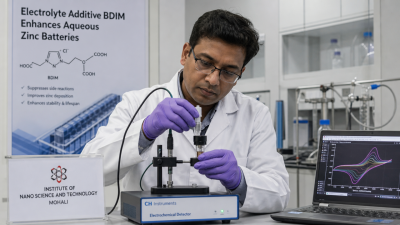
On 29 June 2026, researchers at the Institute of Nano Science and Technology (INST), Mohali, reported an electrolyte additive, 1,3-bis(1,3-dicarboxypropyl)-1H-imidazole-3-ium chloride (BDIM), for aqueous zinc‑ion batteries (AZIBs) in ACS Electrochemistry.
Key innovation
- BDIM (chemical): 1,3-bis(1,3-dicarboxypropyl)-1H-imidazole-3-ium chloride; electrolyte additive developed at INST; published 29 June 2026 in ACS Electrochemistry.
- Target interface: Selective adsorption on zinc metal surface and regulation of the Inner Helmholtz Plane (IHP).
- Water displacement: BDIM displaces interfacial water molecules at the zinc–electrolyte boundary.
Electrochemical effects
- Hydrogen evolution: Suppresses hydrogen evolution reaction (HER) at the zinc interface.
- Corrosion and dendrites: Reduces zinc corrosion and dendrite nucleation and growth.
- Cell performance: Improves cycling stability and extends operational lifespan of AZIB cells.
Research methods
- Diagnostic tools: Laboratory‑developed ultramicroelectrode (UME) combined with fast‑scan cyclic voltammetry (FSCV) to probe zinc‑deposition and interfacial charge‑transfer kinetics.
- Approach: Interface‑engineering via electrolyte design rather than electrode material redesign.
Applications & relevance
- Use cases: Grid‑scale storage, renewable energy buffering and backup power where low cost and aqueous safety are priorities.
- AZIB attribute: Aqueous electrolytes are non‑flammable and zinc is a low‑cost, abundant anode material.
IASPOINT Booster Facts
- INST status: Autonomous institute under Department of Science & Technology (DST).
- IHP definition: The region of specifically adsorbed ions and solvent molecules adjacent to the electrode surface where interfacial reactions occur.
- HER reaction: In acidic/neutral aqueous media, 2H+ + 2e− → H2; a parasitic reaction in AZIBs.