
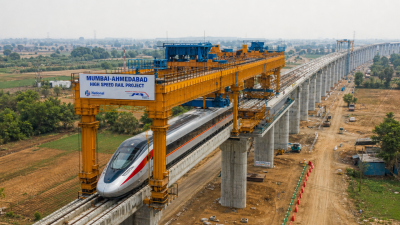
On 3 July 2026 India and Japan reaffirmed their commitment to accelerate the Mumbai–Ahmedabad High‑Speed Rail corridor, with Japan supporting commencement of commercial operations on the priority section by 2027.
Project overview
- Length & stations: ~508 km with 12 planned stations.
- Speeds & travel time: Designed for 350 km/h; operational speed 320 km/h; Mumbai–Ahmedabad travel time ~1 hr 58 min.
- Timeline: First service on priority section expected August 2027 (Surat–Vapi); full commercial service targeted by 2029 (some targets cite end‑2028).
- Key structures: 25 river bridges, 28 steel bridges (14 of 17 in Gujarat completed) and India’s first undersea rail tunnel.
Technology & standards
- Proven platform: Japanese Shinkansen technology is being used.
- Electrical & track systems: 2×25 kV overhead electrification and J‑Slab ballastless track technology.
- Control systems: Advanced signalling and train‑control suites adapted for high‑speed operations.
Manufacturing, depots & skills
- Indigenisation: Integral Coach Factory and BEML developing 280 km/h train sets under Make in India/Aatmanirbhar Bharat.
- Depots: Rolling stock depots at Sabarmati, Surat and Thane.
- Skilling & employment: High‑Speed Rail Training Institute in Vadodara; ~4,000 direct and 35,000–40,000 indirect jobs estimated.
Standardised expansion template
- Network plan: Seven additional corridors identified, ~4,000 km total.
- Investment estimate: Approx. ₹16 lakh crore for proposed corridors.
- Objective: Unified designs, construction methods and operational practices to reduce costs and shorten delivery timelines.
IASPOINT Booster Facts
- Implementing agency: National High Speed Rail Corporation Limited (NHSRCL) is the special purpose vehicle for MAHSR implementation.
- Gauge: Shinkansen systems use standard gauge (1,435 mm) as opposed to India’s broad gauge.
- Rolling stock classification: Train sets designed for commercial operation at speeds ≥ 250 km/h are classified as high‑speed rail by global standards.