
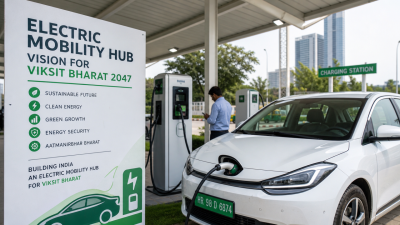
On 2 July 2026 Union Environment Minister Bhupender Yadav presided over the National Conference on “Electric Mobility: Building India an Electric Mobility Hub for Viksit Bharat” in New Delhi. Policymakers, industry and technology providers discussed policy continuity, charging infrastructure, localisation, battery supply chains, financing and regulatory reforms to support a clean manufacturing ecosystem by 2047.
What is the issue
Electric mobility transition seeks large-scale replacement of ICE vehicles with EVs plus development of domestic manufacturing, battery value chains and charging networks. The objective is to position India as a global electric mobility and clean manufacturing hub aligned to the Viksit Bharat 2047 goal.
Why it matters
- Economy: Reduced fossil fuel imports (over 90% reduction possible) and estimated savings of USD 240 billion annually by 2047; domestic manufacturing expansion.
- Jobs: New employment across manufacturing, R&D, battery recycling and services.
- Environment: Lower vehicular emissions and contribution to India’s climate commitments.
- Energy security: Lower exposure to global oil price shocks and geopolitics.
- Technology & industry: Opportunity for value addition in batteries, power electronics and software.
- Governance: Requires policy continuity, faster approvals and coordination across ministries and states.
Vision and strategic importance for Viksit Bharat 2047
The vision is a domestic industrial ecosystem for electric mobility that supports green jobs, circular economy practices, resilient supply chains and international competitiveness. Success would shift value capture from fuel imports to manufacturing and services, strengthen export potential and support climate and air-quality targets.
Key pillars of an Electric Mobility Hub
| Pillar | Rationale | Policy / Action |
|---|---|---|
| Policy continuity | Investor confidence; long-term planning | Stable incentives, multi-year targets, state alignment |
| Charging infrastructure | Range anxiety; urban & rural access | Public‑private roll‑out, interoperable fast chargers, standards |
| Localisation of manufacturing | Value addition, supply security | Incentives for OEMs, MSMEs, PLI for ACC batteries |
| Resilient battery supply chains | Critical minerals, processing concentration | Domestic capacity, diversified imports, recycling |
| Financing support | High upfront costs for buyers & infrastructure | Subsidies, concessional loans, innovative financing models |
| Technological innovation | Cost reduction, performance gains | R&D grants, testbeds, industry–academy partnerships |
Governmental reforms and policy framework
- Environmental clearances: Simplified procedures to speed investment while retaining safeguards.
- Digital approvals: PARIVESH portal for single-window environmental clearances and compliance monitoring.
- Compliance rationalisation: Streamlined rules to improve ease of doing business for EV projects.
- State policy model: Delhi EV Policy 2026 flagged as an example for speeding adoption, charging roll‑out and clean public transport.
- Industry roadmap: ASSOCHAM 2.0 aligns private-sector planning with Make in India, MSME growth and sustainability goals.
- Existing schemes: Continued use and scaling of FAME, PLI for battery manufacturing and sectoral incentives where required.
Role of industry and private sector
- Manufacturers (OEMs, battery firms): Invest in local plants, component ecosystems and R&D.
- Charging operators: Build networks with interoperable standards and business models for urban, highway and rural coverage.
- MSMEs: Supply components, assembly and services; require credit and technology support.
- Industry bodies: Convene policy dialogue; ASSOCHAM-led initiatives align industry with national vision.
- Finance sector: Develop leasing, EV loan packages and infrastructure financing instruments.
- Public–private partnerships: Combine public planning and uptake guarantees with private execution and innovation.
Challenges and implications
| Challenge | Implication | Mitigation |
|---|---|---|
| Charging infrastructure gaps | Adoption stalled; inequitable access | Mandated charger density, public funding, PPPs, interoperable standards |
| Battery supply chain dependence | Import vulnerability; price volatility | Domestic ACC capacity, mineral exploration, strategic import diversification |
| Financing constraints | Slow consumer uptake and project delays | Subsidies, credit lines, battery-as-a-service models |
| Grid stability and energy mix | Peak load management, emissions from power sector | Smart charging, time-of-use pricing, integration with renewables |
| End-of-life battery management | Resource loss and pollution risks | Battery recycling value chains, second‑life use, EPR rules |
Strategies for accelerating adoption and infrastructure
- Policy predictability: Multi-year roadmaps and aligned state policies to reduce regulatory risk.
- Charging network plan: National targets for public fast-charging corridors and urban coverage with private participation.
- Local manufacturing: Incentives and cluster development for OEMs and component suppliers, support for MSMEs.
- Battery ecosystem: Expand ACC manufacturing, support mineral exploration, and encourage recycling and second-life markets.
- Financing instruments: Subsidies, concessional finance, leasing and demand aggregation for fleet electrification.
- Standards and interoperability: National standards for chargers and connectors; BIS and testing regimes.
- Grid and renewables integration: Smart charging, vehicle-to-grid pilots and renewable energy linkages.
- Skills and R&D: Training programmes, technology incubation and international collaboration on advanced chemistries.
Green growth and circular economy linkages
Electric mobility supports green growth by shifting energy consumption from imported oil to electricity, which can be increasingly low‑carbon. Circular economy measures conserve critical materials and reduce environmental risk. Key actions include mandatory recycling targets, second‑life battery markets for stationary storage, extended producer responsibility for battery makers and design-for-recycling norms. These reduce import demand and close material loops within the domestic industry.
Socio-economic and environmental benefits
- Job creation: Manufacturing, maintenance, charging services, recycling and R&D roles across skill levels.
- Manufacturing growth: Domestic value addition in vehicles, batteries and power electronics.
- Energy security: Large reduction in crude imports and foreign exchange savings (estimated USD 240 billion annually by 2047).
- Air quality and health: Lower tailpipe emissions in cities and reduced public health costs.
- Export potential: Clean manufacturing can expand India’s presence in global EV and battery markets.
Model Questions
1. Evaluate the significance of India’s electric mobility transition in achieving the ‘Viksit Bharat by 2047’ vision, particularly through its contribution to a sustainable industrial ecosystem, green jobs, and energy security. [GS-III: Economic Development]
A structured electric mobility transition redirects value from fuel imports to domestic manufacturing and services, creating green jobs across manufacturing, charging and recycling. It enhances energy security by reducing crude import dependence (possible >90% reduction) and yields large foreign exchange savings (estimated USD 240 billion annually by 2047). The shift supports export potential, cleaner cities and aligns industrial policy with environmental targets when paired with localisation and supply‑chain resilience.
2. Analyse the key policy, governance and infrastructural pillars necessary to position India as a global electric mobility hub. Critically examine recent government reforms and industry initiatives. [GS-II: Governance]
Key pillars are policy continuity, charging infrastructure, localisation, resilient battery chains, financing and R&D. Recent reforms—simplified environmental clearances, digital approvals via PARIVESH and compliance rationalisation—reduce project lead times. Delhi EV Policy 2026 and ASSOCHAM 2.0 offer state and industry roadmaps. Effectiveness requires inter‑ministerial coordination, clear long‑term incentives and state-level replication to translate policy signals into investments and deployment.
3. Discuss challenges in establishing a resilient battery supply chain and robust charging infrastructure in India. Suggest measures to overcome these hurdles. [GS-III: Science & Technology]
Challenges: dependence on imported critical minerals, limited domestic ACC capacity, uneven charger coverage and grid impacts. Measures: scale ACC manufacturing via PLI and investment incentives; promote domestic mineral exploration and diverse import partners; set charging standards and mandate charger density; launch PPPs and concessional finance for networks; upgrade distribution grids, implement smart charging and V2G pilots; enforce recycling and second‑life frameworks to recover materials.
4. How does the vision of India becoming an electric mobility hub align with green growth and circular economy principles? Discuss the role of public‑private partnerships in driving this industrial transformation. [GS-III: Environment & DM]
Electric mobility reduces fossil fuel use and emissions when power is progressively decarbonised, supporting green growth. Circular economy measures—battery reuse, recycling and EPR—conserve critical materials and limit pollution. PPPs mobilise capital and technical expertise for charging networks, recycling plants and manufacturing clusters. Public procurement, demand guarantees and R&D co‑funding can de‑risk private investment and accelerate scalable, environmentally responsible industrial development.
Last Modified: July 4, 2026