
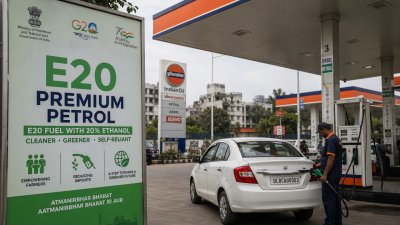
On 5 July 2026 the government factsheet reported that India’s Ethanol Blended Petrol (EBP) Programme reached 20% blending by December 2025 and has saved over ₹1.90 lakh crore in foreign exchange by substituting 310 lakh metric tonnes of crude oil since 2014‑15.
Key statistics
- Blending progression: From <1.5% in 2013‑14 to 20% by Dec 2025; target achieved five years early.
- Production & procurement: Installed ethanol capacity ≈ 2,000 crore litres (2026); procurement >1,200 crore litres in 2025‑26.
- Energy, emissions & farmer income: Substituted ~310 lakh MT crude oil; saved ₹1.90 lakh crore forex; CO2 reduction ≈ 930 lakh tonnes; additional farmer earnings >₹1.60 lakh crore.
Technical & vehicle compatibility
- E20 specification: 20% ethanol blend; conforms to BIS and BS‑VI fuel standards.
- Testing & field data: ARAI/SIAM-led evaluations; field trials — cars 40,000 km, two‑wheelers 20,000 km; major OEMs report compatibility and no warranty voidance.
- Fuel properties: Raises octane number and improves combustion efficiency versus neat petrol.
Policy & rollout
- Flex‑fuel recognition: MoRTH draft (Apr 2026) to recognise E85 and E100 flex‑fuel vehicles.
- E85 retail expansion: 48 public OMC retail outlets began E85 (June 2026); targets — 500 by Dec 2026, 5,000 by Dec 2027.
- Feedstocks: Ethanol sourced primarily from sugarcane/sugar industry and alternative feedstocks under procurement contracts.
International context
- Comparative blends: USA uses E10/E15, Brazil E27, Japan E10 — international precedence for ethanol blends.
IASPOINT Booster Facts
- Regulatory agencies: BIS sets fuel specifications; ARAI conducts homologation; SIAM represents manufacturers.
- Emission accounting note: Reported CO2 savings reflect fossil petrol substitution; life‑cycle emissions depend on feedstock and production pathway.