
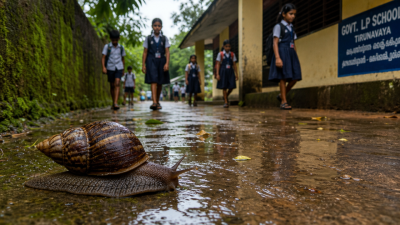
As of 4 July 2026 the invasive giant African snail (Lissachatina fulica) is spreading across Tirunavaya panchayat in Kerala and entering school campuses, prompting health alerts for children.
Species & Health Risks
- Scientific identity: Lissachatina fulica; family Achatinidae; large terrestrial gastropod.
- Vector of parasite: Carries Angiostrongylus cantonensis (rat lungworm), the principal cause of human eosinophilic meningitis.
- Clinical risk: Eosinophilic meningitis characterised by peripheral/CSF eosinophilia; children under 10 reported disproportionately.
- Allergic potential: Mucus contact can provoke allergic reactions.
- Conservation status: Listed among IUCN’s 100 worst invasive alien species.
Distribution & Spread
- Kerala history: First reported in 1950s at Elapully, Palakkad.
- Extent by 2023: Recorded at over 270 locations across all 14 districts of Kerala.
- Current locus: Rapid local spread in Tirunavaya panchayat; incursions into school premises noted 4 July 2026.
Control & School Measures
- Preventive: Install mesh screens on classroom and bathroom openings to block entry.
- Handling: Use gloves when removing snails; avoid bare-hand contact.
- Local practices: Residents employ salt and tobacco–copper sulphate mixtures to kill snails.
Research & Reports
- Study: Led by Kerala Forest Research Institute in collaboration with University of Nottingham, Natural History Museum (London) and UAE Environmental Agency.
- Clinical reports: Two Kochi hospitals reported a rise in eosinophilic meningitis cases, mostly in children, as of late June 2026.
IASPOINT Booster Facts
- Native range: East Africa; now globally invasive via human-mediated transport.
- Public-health term: Angiostrongyliasis denotes human infection by A. cantonensis.