
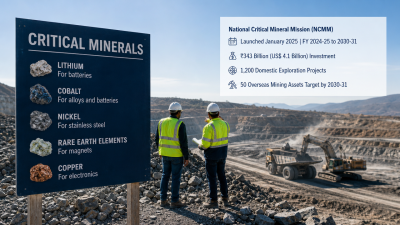
India has moved to secure critical mineral supplies through diplomatic deals and domestic programmes. Recent MoUs with Indonesia and expanding partnerships, alongside the National Critical Mineral Mission and KABIL’s overseas work, aim to reduce import risks and fast-track domestic exploration and processing capacity.
What is the current issue?
India depends heavily on imports for several critical minerals used in clean energy, defence and high-tech manufacturing. Processing capacity for rare earths, graphite and refined cobalt is concentrated abroad. Supply concentration and low domestic exploration create strategic and economic vulnerabilities.
Why it matters
- Economic: Input costs and manufacturing competitiveness for EVs, renewables and electronics are exposed to supply shocks.
- Security: Defence platforms and critical infrastructure require assured supplies and processing capabilities.
- Industrial policy: Downstream industries need reliable feedstock and technology for value addition.
- Environment & society: New mining and processing require strict environmental governance and community consent.
India’s import dependence and global processing concentration
Import-intensity is high for key items: bismuth (85.6%), lithium (82%), silicon (76%), titanium (50.6%), tellurium (48.8%) and graphite (42.4%). Global processing is concentrated — over 90% for rare-earth processing, 95% for graphite processing and 79% for refined cobalt — creating geoeconomic risk.
National Critical Mineral Mission (NCMM)
Mandate and scale
- Scope: Domestic exploration, resource mapping, processing & R&D for critical minerals.
- Funding: INR 343 billion for FY 2024-25 to 2030-31.
- Targets: 1,200 domestic exploration projects and 50 overseas mining asset acquisitions by 2030–31.
- Implementation: Geological Survey of India (domestic exploration lead); coordination with ministries, PSUs and research bodies.
Khanij Bidesh India Limited (KABIL)
- Role: Acquire critical mineral assets abroad to secure long-term supply.
- Focus: Lithium and cobalt; target countries include Argentina, Australia and Chile.
- Progress: Environmental clearance in Argentina to begin deep exploration of five brine lithium blocks in Catamarca province. Active asset acquisition pipeline.
Reforms in mineral exploration policy
Current policy shortfall
- Exploration licences are generally awarded by auction. This deters private risk capital for frontier exploration where discovery probabilities are low.
- Private exploration spending in India remains below USD 5 million annually.
Proposed reforms and rationale
- First-come, first-served licences for unexplored areas to lower entry barriers and speed prospecting.
- Security of tenure: Allow transition from exploration to mining rights on commercial discovery to de-risk investments.
- Incentives: Fiscal support, exploration credits, phased auctioning, and public co-funding for high-risk work.
- Regulatory predictability: Clear timelines for approvals, standardised environmental baseline requirements and transparent land access protocols.
International cooperation and supply-chain diversification
- Diplomacy: India has expanded partnerships to 35 countries for diversification, including recent MoUs with Indonesia for steel, nickel and rare-earth magnet manufacturing.
- Tech and investment pacts: New working groups with France and cooperation pacts with Japan aim to strengthen exploration, processing, recycling and technology transfer.
- Strategic procurement: KABIL’s overseas acquisitions and bilateral MoUs reduce single-source dependency and secure feedstock for domestic manufacturing.
Circular economy and secondary sources
- Policy action: NITI Aayog is developing a framework for recovering critical minerals from mine waste (overburden, tailings) and from urban mining (e-waste, spent batteries).
- Benefits: Reduces import pressure, lowers environmental footprint, and creates domestic material loops for battery chemistry and rare-earths.
Challenges
| Challenge | Implication | Policy response |
|---|---|---|
| Geoeconomic concentration of processing | Supply disruption risk and limited bargaining power | International partnerships, build domestic processing and incentivise FDI in downstream |
| Low private exploration | Insufficient discovery pipeline | Exploration-rule reforms, tenure security, fiscal incentives |
| Technological gaps | Poor ore-to-metal conversion and recycling capability | R&D funding, industry-academia collaboration, tech transfer agreements |
| Environmental and social risks | Local opposition, compliance costs, litigation | Stronger environmental standards, community benefit sharing, rehabilitation funds |
| Financing and market risk | High upfront costs deter investors | Public co-financing, blended finance, viability gap funding for strategic projects |
Way forward — operational priorities
- Implement exploration reforms: Adopt first-come, first-served licensing for greenfield areas, bind tenure conversion rules and simplify approvals.
- Mobilise private risk capital: Offer fiscal incentives, exploration credits and public–private exploration funds.
- Scale processing capacity: Attract investment in refining and separation technologies; pursue joint ventures with partner countries.
- Strengthen R&D and skills: Fund applied research in metallurgy, hydrometallurgy and recycling; expand training in geological sciences.
- Advance circular economy: Operationalise NITI Aayog policy, mandate EPR for batteries and e-waste, and incentivise industrial symbiosis.
- Use diplomacy strategically: Secure long-term supply via MoUs, asset acquisition through KABIL, and multilateral engagements to diversify sources.
- Ensure environmental governance: Enforce strict environmental standards, transparent consent processes and community benefit mechanisms for new projects.
Model Questions
1. India faces high import dependence for several critical minerals and concentrated global processing. Discuss the implications for the economy and national security and evaluate the strategic measures India has adopted to mitigate these risks. [GS-III: Economic Development]
India’s import dependence raises supply-chain vulnerability, price exposure for manufacturing (EVs, renewables, defence), and strategic risk if processing hubs are disrupted. Measures include the National Critical Mineral Mission for domestic exploration, KABIL’s overseas asset acquisitions, diplomatic MoUs to diversify suppliers, and R&D and recycling initiatives. Complementary measures needed are processing capacity building, exploration reforms to attract private risk capital, and stockpiling for critical inputs.
2. Examine the roles and progress of the National Critical Mineral Mission and Khanij Bidesh India Limited in securing mineral self-reliance. [GS-III: Economic Development]
NCMM provides funding, mapping and a target-driven exploration push (1,200 projects domestically; 50 overseas asset goals), led by Geological Survey of India. KABIL focuses on acquiring overseas lithium and cobalt assets to secure feedstock, with advance in Argentina for brine exploration. Together they combine domestic resource discovery with overseas supply assurance, while needing faster implementation, processing linkages and private-sector engagement.
3. Critically analyse current exploration policy constraints and how proposed reforms—such as first-come, first-served licences and tenure security—can mobilise private risk capital. [GS-III: Economic Development]
Auction-based awards deter private explorers from high-risk greenfield work. First-come, first-served licences reduce entry barriers and speed up ground work. Tenure security that allows conversion to mining rights on discovery de-risks investment horizon. Fiscal incentives, exploration credits and predictable approvals further attract capital. Reforms must balance investor rights with environmental safeguards and local consent to be effective.
4. Assess the role of circular economy measures and international partnerships in building a resilient critical mineral supply chain for India. [GS-III: Environment & DM]
Circular measures—mine-waste recovery, urban mining for e-waste and battery recycling—can reduce import needs and environmental harm. NITI Aayog’s policy work aims to operationalise these routes. International partnerships diversify supplies, secure processing and enable technology transfer. Combined, these actions lower single-source exposure and support domestic value addition; success requires standards, incentives for recycling infrastructure and coordinated diplomacy.
Last Modified: July 7, 2026