
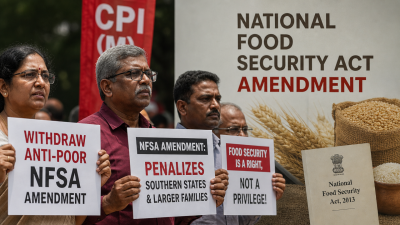
The Union government has proposed amending NFSA AAY entitlements from a fixed 35 kg per household to 7 kg per person (capped at 35 kg/household). Tamil Nadu and Kerala have publicly opposed the change, citing reduced allocations for vulnerable households and adverse effects on states with smaller average family sizes.
What is the issue?
Core change
- Current: Antyodaya Anna Yojana (AAY) — 35 kg foodgrains per household per month.
- Proposed: 7 kg per person, subject to a maximum of 35 kg per household per month.
- Rationale (Union F&PD): Correct perceived inequities in household-based entitlements and better align distribution with nutritional needs.
Why it matters
- Food security: AAY targets the poorest households; any reduction directly affects daily food access and nutrition.
- Federal relations: States view uniform rules as potentially punitive to their demographic choices and programmes.
- Equity and targeting: Change alters per capita allocation patterns across states and household sizes.
Government rationale and policy logic
- Equity argument: Household-based entitlements give smaller families higher per-person allocations; per-capita aims to equalise per-person access.
- Nutritional alignment: Per-person norms are presented as more directly linked to caloric and protein needs.
- Administrative intent: Draft amendment published by the Food & Public Distribution Department to invite comments and effect legal change.
State objections — Tamil Nadu and Kerala
- Tamil Nadu position: Chief Minister C. Joseph Vijay urged retention of 35 kg/household. State estimates a reduction in monthly AAY allocation from 65,261 tonnes to 42,040 tonnes, affecting nearly 70 lakh vulnerable persons. Average household size cited: 3.54 members.
- Kerala position: Food Minister Anoop Jacob expressed reservations about the amendment’s impact on beneficiaries.
- Core claim: States with smaller family sizes will be penalised despite successful family planning and public-health outcomes.
Political and civil-society opposition
- CPI(M): Described the amendment as “anti-poor”, arguing both larger and some smaller families would be disadvantaged by the 7 kg/person rule with a 35 kg cap.
- Mass organisations: AIAWU, AIDWA, AIKS and CITU announced nationwide protests, asserting the amendment reduces food security for millions.
- Systemic criticism: Critics note NFSA beneficiary lists still rely on the 2011 Census, leaving an estimated 14 crore eligible persons excluded; amendment does not address this exclusion error.
Comparison: current vs proposed entitlement
| Dimension | Current (AAY) | Proposed |
|---|---|---|
| Unit of entitlement | 35 kg per household per month | 7 kg per person per month (max 35 kg per household) |
| Effect on small households | Highest per-capita allocation for 1–2 member families | Per-capita equalisation; many small households lose grain |
| Effect on large households | Lower per-capita allocation | Cap may still limit total; some larger households get lower overall grain than needed |
| State example (Tamil Nadu) | Monthly allocation: 65,261 tonnes (AAY) | Estimated monthly allocation: 42,040 tonnes (post-change) |
Federalism and governance implications
- Uniformity vs diversity: A single national rule can ignore state-specific demographics, fertility outcomes and welfare design choices.
- Cooperative federalism: Unilateral legislative changes on welfare entitlements risk heightening centre–state friction without substantive prior consultation.
- Administrative feasibility: Implementation requires updated household data, grievance redressal, and coordination with state-run fair price shop networks.
Social justice and food security dimensions
- Target group risk: AAY beneficiaries are among the most food-insecure; reductions increase hunger and malnutrition risk.
- Exclusion/ inclusion errors: Persisting reliance on 2011 Census and outdated lists means exclusion of eligible persons remains a central problem.
- Nutritional adequacy: Per-capita grain norms do not automatically guarantee dietary diversity or micronutrient sufficiency; complementary nutrition programmes (ICDS, mid-day meals) remain essential.
Operational and data challenges
- Beneficiary database: Need to update beneficiary lists beyond 2011 Census—options include SECC refresh, household surveys or linkage with revenue records.
- Technology: e-PDS, Aadhaar seeding and One Nation One Ration Card (ONORC) can improve targeting and portability but cannot by themselves correct entitlement quantum.
- Procurement and supply: Any reduction in entitlement changes procurement planning, buffer stocks and central subsidy outlays; states may face transition pressures.
Economic implications
- Subsidy optimisation: Government may view per-capita norms as a way to rationalise subsidy outlays; fiscal savings depend on coverage changes and procurement costs.
- State budgets: States may need to top up entitlements if central change reduces grain; poorer states may lack fiscal space to do so.
- Market effects: Reduced PDS offtake could affect grain offtake, market prices and procurement incentives for farmers.
Ethical and policy trade-offs
- Distributive justice: Policy must balance equal per-person allocation against compensatory needs of larger households and the goal of protecting the poorest.
- Principle of no-harm: Welfare reforms should avoid making currently covered vulnerable groups worse off.
- Transparency and consent: Major welfare changes demand public impact assessments and state-level consultation.
Way forward — operational and policy options
- Update beneficiary lists: Use SECC update, targeted household surveys or administrative databases to replace sole reliance on 2011 Census.
- Conduct impact assessment: State-wise simulations of entitlement change before legal amendment; publish results and consult states.
- Flexible entitlement models: Consider state-specific or phased approaches that protect existing beneficiaries while moving towards per-capita equity where justified.
- Strengthen PDS delivery: Expand e-PDS, ONORC, real-time monitoring and grievance redress to reduce leakages and ensure targeted reach.
- Complementary nutrition actions: Preserve and integrate ICDS, mid-day meals and food fortification to address micronutrient needs not met by cereals alone.
- Fiscal planning: Align procurement, buffer stocks and subsidy allocations with any entitlement changes to avoid supply shocks.
- Consultative process: Formal centre–state consultations and inclusion of civil-society stakeholders before finalising legal changes.
Model Questions
1. Analyse the concerns raised by states like Tamil Nadu and Kerala regarding the per-capita change in AAY entitlements and its implications for cooperative federalism and social justice. [GS-II: Governance]
Tamil Nadu and Kerala argue per-capita change reduces overall grain for AAY households, penalising states with smaller families (TN average 3.54 members). Effects include estimated reduced allocations (TN: 65,261 → 42,040 tonnes) and harm to nearly 70 lakh persons. Policy risks eroding cooperative federalism by imposing uniform rules without state consultation. Remedy: state-wise impact assessments, phased implementation, and protection clauses for vulnerable households.
2. Critically evaluate the Union government’s stated objectives for amending NFSA AAY entitlements against criticisms by opposition parties and mass organisations. [GS-II: Social Justice]
Government argues per-capita norms correct inequities and align with nutritional needs. Critics contend the 7 kg/person with 35 kg cap reduces entitlements for many AAY households and disadvantages both smaller and larger families. Mass organisations warn of nationwide food insecurity. Key gaps: absence of updated beneficiary lists (2011 Census exclusions ~14 crore) and lack of published state-wise impact analyses. Policy must reconcile equity goals with practical protection of the poorest.
3. Discuss the evolution and operational challenges of India’s Public Distribution System in ensuring food security, with reference to the proposed NFSA amendment. [GS-III: Economic Development]
PDS evolved from universal rations to TPDS and NFSA guarantees. Challenges persist: leakage, outdated beneficiary lists, procurement constraints, and uneven state capacity. Proposed entitlement change adds complexity: requires fresh data, supply-side adjustments and safeguards for vulnerable groups. Strengthening e-PDS, ONORC, frequent beneficiary updates, and aligning procurement with revised demand are essential to preserve food security and programme credibility.
4. Examine the ethical considerations and governance challenges in implementing uniform welfare policies across a diverse federal structure like India, in light of the NFSA amendment controversy. [GS-IV: Ethics, Integrity and Aptitude]
Ethical issues include distributive justice and fairness: uniform policy may penalise states that achieved demographic gains. Governance challenges: inadequate consultation, data gaps and the risk of worsening outcomes for vulnerable groups. Ethical governance requires impact assessments, transparent criteria, safeguards (no-harm clauses), and participatory decision-making to balance national uniformity with local realities.
Last Modified: July 10, 2026