
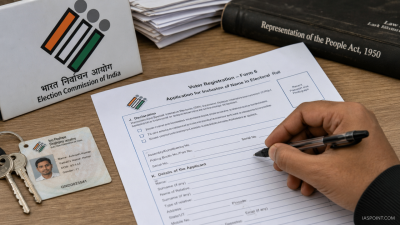
The Election Commission of India has added a family‑linkage declaration to the online Form 6 on its ECINET portal. Applicants must state if their name, or a parent’s or grandparent’s name, appeared in the last Special Intensive Revision (SIR); online submission is blocked without completing this field.
What is the current change?
Online Form 6 update
The ECINET version of Form 6 now contains a compulsory family‑linkage declaration placed between Parts J and K. Applicants select one of three options: their own name was in the last SIR; a parent’s or grandparent’s name was in it; or none were listed. If listed, the portal requires Assembly constituency number, part/polling booth number and serial number.
Why this matters
The declaration feeds family‑based progeny mapping used in the Special Intensive Revision (SIR). SIR is a field verification exercise for purging duplicate, deceased, shifted, absent and foreign electors. Making the online field mandatory affects access to registration, verification workload for Booth Level Officers (BLOs) and intersects with citizenship processes in sensitive states.
Constitutional and statutory framework
- Authority: Article 324 vests superintendence, direction and control of elections in the ECI, headed by Chief Election Commissioner Gyanesh Kumar.
- Statute and rules: Electoral rolls and registration are governed by the Representation of the People Act, 1950 and the Registration of Electors Rules, 1960. Form 6 is the statutory application for inclusion in the roll.
- Judicial position: The Supreme Court upheld the constitutional validity of SIR in May 2026, confirming it falls within the ECI’s mandate under Article 324.
Administrative divergence: online directive vs statutory form
The new declaration was introduced by administrative instruction on ECINET rather than by a notified amendment to the statutory Form 6. The offline statutory PDF remains unchanged. Practically, online applicants cannot submit without the declaration. This creates a procedural divergence between online and offline processes and raises questions of rule‑consistency and parliamentary oversight.
| Aspect | Offline statutory Form 6 | ECINET online Form 6 |
|---|---|---|
| Legal status | Statutory application under rules | Portal implementation by administrative instruction |
| Family‑linkage field | Not updated | Mandatory to submit |
| Submission requirement | Can be submitted without family details | Submission blocked unless completed |
Mechanics of SIR and progeny mapping
SIR is a field‑based verification to identify duplicates, deceased, shifted, absent and foreign electors. Family‑linkage information allows progeny mapping: linking households across generations to detect redundant entries and verify continuity. Inputs required (constituency, booth/part, serial) enable targeted physical verification by BLOs and automated database cross‑checks.
Regional and security context: Assam and NRC
The family‑linkage declaration applies where SIR has been conducted or is underway. Assam is excluded because SIR there remains on hold pending completion of the National Register of Citizens (NRC), an independent citizenship exercise. Suspension avoids administrative conflict between citizenship adjudication and electoral revision in a sensitive border state.
Operational and equity challenges
- Risk of disenfranchisement: Mandatory online fields requiring ancestral booth/serial details may exclude first‑generation voters, migrants, homeless persons and those lacking documentary memory.
- Digital divide: Citizens with limited internet access or low digital literacy face higher barriers when the portal enforces mandatory fields.
- Administrative burden: Progeny mapping increases verification workload for BLOs and returning officers, and may require substantial data‑cleaning resources.
- Legal and procedural fairness: A divergence between online practice and statutory form raises questions about procedure‑by‑administrative‑directive versus rule‑making under the Act and Rules.
Data protection, transparency and governance risks
- Privacy: Collection and storage of ancestral details require clear data‑protection safeguards and limited retention policies.
- Transparency: Applicants need clear guidance on acceptable alternatives when ancestral details are unavailable. Public communication must state how data will be used and corrected.
- Grievance redress: Fast, accessible channels are required to resolve verification delays that may affect enrolment before elections.
Policy options and practical safeguards
- Statutory harmonisation: The ECI and Ministry of Law and Justice should align online portal changes with formally notified amendments to rules or issue transparent administrative orders explaining legal basis and limits.
- Alternative verification routes: Allow self‑declaration plus physical verification by BLOs where ancestral SIR data is unavailable. Accept local attestations, ration card, Aadhaar linkage or residence proof as interim measures.
- Phased and regional approach: Expand SIR‑linked requirements only after capacity building at booth and district level. Keep sensitive regions with parallel citizenship processes on a tailored timeline.
- Capacity building: Strengthen BLO training, digital infrastructure and data‑cleaning teams. Provide mobile enrolment drives to reach marginalised groups.
- Data governance: Define minimisation, purpose limitation and retention rules for family‑linkage data. Publish SOPs for progeny mapping and human review of automated matches.
- Monitoring and review: Institute periodic audits, third‑party oversight and a quick grievance resolution protocol to prevent mechanical rejection of legitimate applications.
Model Questions
1. Examine the constitutional and statutory validity of modifying online voter registration procedures through administrative instructions rather than by amending the Registration of Electors Rules. [GS-II: Constitution of India & Polity]
The ECI has wide powers under Article 324 to supervise elections, and the Supreme Court affirmed SIR’s validity. However, rule changes affecting a statutory form normally require formal amendment under the Representation of the People Act and notified rules. Administrative directives that create practical preconditions for registration risk procedural inconsistency, reduced legal certainty and challenge in courts. Harmonisation via formal rule‑making is advisable to ensure legality and oversight.
2. Assess the utility and risks of using family‑linkage data and progeny mapping in electoral roll verification. Suggest safeguards to balance accuracy and access. [GS-II: Governance]
Family‑linkage assists targeted de‑duplication and detection of shifted or deceased electors, improving roll accuracy. Risks include exclusion of first‑generation voters, migrants and digitally marginalised groups, and privacy concerns. Safeguards: accept alternative proofs, permit BLO‑led physical verification, implement data‑minimisation and retention rules, provide clear public guidance, and ensure accessible grievance redress to prevent mechanical disenfranchisement.
3. Analyse administrative and security implications of suspending SIR in states undergoing citizenship verification, with reference to Assam. [GS-III: Internal & External Security]
Suspending SIR in Assam avoids conflicts between electoral revision and the NRC, reducing administrative contradiction and litigation risk. However, it leaves rolls unpurged, which may hamper electoral planning and local security intelligence. Temporarily frozen revisions require alternative monitoring of irregularities and clear post‑NRC integration protocols to synchronise citizenship determinations with electoral inclusion without compromising border‑security and demographic integrity.
4. Discuss the ethical challenges electoral bodies face when pursuing database purity while protecting the right to vote. Recommend procedural principles to manage the trade‑off. [GS-IV: Ethics, Integrity and Aptitude]
Ethical tension arises when stringent verification improves integrity but risks excluding legitimate electors. Principles: prioritise universal franchise, apply the least‑restrictive verification methods, ensure proportionality between evidence demanded and risk mitigated, guarantee transparency and appeal, and deploy human‑centred processes (BLO verification) to correct algorithmic or data errors and protect vulnerable voters from mechanical exclusion.
Last Modified: July 13, 2026