
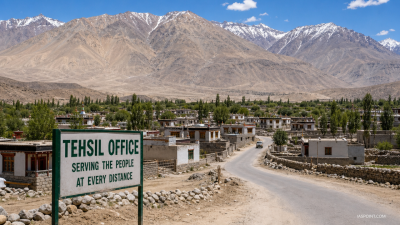
On 12 July 2026 Ladakh approved creation of 17 new tehsils, increasing the total from 15 to 32; the reorganisation aligns every revenue village with a single tehsil and every tehsil with a single district.
Tehsil: role and features
- Definition: Sub‑district revenue and administrative unit for land records, revenue collection and certain local regulatory functions.
- Head: Administered by a Tehsildar (revenue officer) in the revenue hierarchy.
- Synonyms: Also called taluka or mandal in various states.
New tehsil distribution in Ladakh
- Leh: 5 tehsils.
- Kargil: 7 tehsils.
- Changthang: 4 tehsils.
- Nubra: 6 tehsils.
- Zanskar: 4 tehsils.
- Sham: 5 tehsils.
- Drass: 1 tehsil.
Revenue villages and administrative mapping
- Revenue village: Smallest unit for land and tax records; used in cadastral rolls.
- Mapping change: Removes prior tehsil–district jurisdictional overlaps by one-to-one alignment.
Implementation and operational details
- Approval: Reorganisation sanctioned by the Union Territory administration on committee recommendations.
- Staffing: Tehsildars to be appointed; one officer given independent charge for each new unit.
- Access impact: Aims to shorten administrative travel in remote border areas where journeys to centres can exceed 300 km.
IASPOINT Booster Facts
- UT status: Ladakh became a Union Territory without legislature on 31 October 2019 under the Jammu and Kashmir Reorganisation Act, 2019.
- Administrative law: Revenue administration functions derive from state/central land revenue laws and delegated rules applicable to UTs.
- Geography: Changthang is a high‑altitude plateau influencing settlement and administrative access.