
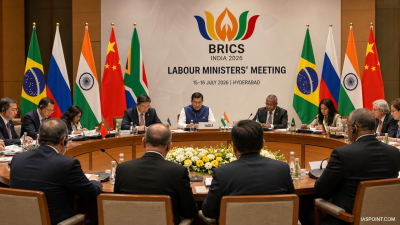
India will host the BRICS Labour and Employment Ministers’ Meeting in Hyderabad on 15–16 July 2026 under its BRICS presidency. The meeting links BRICS cooperation on labour markets, workforce skilling, social protection and employment policy.
BRICS Framework for Labour Cooperation
- Members: Brazil, Russia, India, China, South Africa.
- Sectoral ministerial meetings: Formal mechanism for coordination on labour, health, education and finance issues.
- Employment Working Group (EWG): Technical track that prepares inputs on employment, skills and social security for ministers.
Key Labour Policy Themes (exam-relevant)
- Labour market formalisation: Measured by formal contract prevalence, social security coverage and registered enterprises.
- Skills and employability: Includes vocational training, apprenticeships and Recognition of Prior Learning (RPL).
- Social protection: Distinguishes contributory (insurance) from non-contributory (assistance); tracked by coverage rates and replacement rates.
- Women’s participation: Tracked by LFPR and female-to-male participation ratio; influenced by care infrastructure and labour regulations.
Institutions and Instruments
- International Labour Organization (ILO): UN specialised agency; conventions bind states only after ratification.
- International Social Security Association (ISSA): Global body for social security administration and policy exchange.
- BRICS declarations: Non‑binding joint statements recording agreed cooperation modalities.
IASPOINT Booster Facts
- ILO C87 & C98: Core conventions on freedom of association and collective bargaining.
- Recommendation 202 (2012): ILO social protection floor guiding minimum guarantees.
- Key indicators: Labour Force Participation Rate, ILO unemployment rate, share of informal employment.