
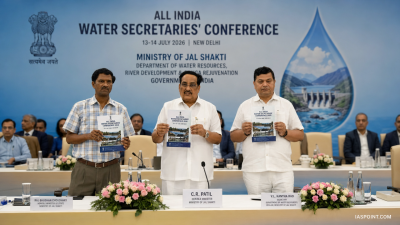
The All India Water Secretaries’ Conference convened in New Delhi on 13 July 2026 under the Department of Water Resources, River Development & Ganga Rejuvenation, Ministry of Jal Shakti. Union Minister C. R. Patil chaired the meeting; three documents — Varanasi action plan, O&M manual for recharge structures, and SoR for drilling works — were released to guide implementation.
What is current
The conference aligned centre and states on short-term targets under the “Jal Surakshit, Bharat Surakshit” objective. States committed to complete Comprehensive Dam Safety Evaluation (CDSE) for specified dams by December 2026 and to scale up the Catch the Rain 2026 campaign for rainwater harvesting and recharge.
Why this matters for governance and security
Water scarcity and infrastructure risk affect agriculture, urban services, disaster resilience and public health. Coordinated policy action reduces interstate friction, improves asset safety, and conserves groundwater — thereby protecting livelihoods, maintaining food supplies and reducing migration pressure from water-stressed areas.
Federalism and centre–state coordination
Legal and constitutional context
- Division of responsibilities: Water supply and irrigation are primarily state subjects; regulation of inter‑state rivers and national schemes involve the Centre.
- Institutional instruments: The Ministry of Jal Shakti provides policy direction; the All India Water Secretaries’ Conference is a regular administrative platform for policy convergence.
Operational measures agreed
- Standardisation: Central releases such as the Schedule of Rates (SoR) for drilling by the CGWB introduce uniform procurement and pricing norms to reduce cost variation and delays.
- Time‑bound targets: States committed to CDSE completion for specified dams by December 2026 under the Dam Safety Act, 2021.
- Incentives and capacity support: Central technical manuals and action plans (e.g., Varanasi reuse plan, O&M manual) are supplied to states for replication and scale-up.
Groundwater depletion and community-led conservation
- Drivers of depletion: Over‑extraction for irrigation, subsidised power, absence of extraction controls, and limited recharge infrastructure.
- Campaigns and tools: Catch the Rain 2026 seeks to expand rainwater harvesting and local recharge; the O&M Manual for Artificial Recharge provides maintenance protocols to sustain benefits.
- Community role: Village-level planning, participatory aquifer mapping, farmers’ cropping choices and water-user associations are necessary to shift extraction patterns.
- Policy levers: Metering and rationalising electricity subsidies, targeted incentives for micro‑irrigation, and financing for community recharge structures enhance demand management.
Dam safety and infrastructure management
- Statutory framework: Dam Safety Act, 2021 mandates State Committees on Dam Safety and State Dam Safety Organisations for inspection, surveillance and emergency planning.
- Evaluation targets: Comprehensive Dam Safety Evaluation for specified dams to be completed by December 2026 to detect structural risks and plan remedial works.
- Risk reduction measures: Periodic instrumented monitoring, updated inundation maps, downstream evacuation plans, and maintenance funding pipelines reduce hazard exposure.
- Climate dimension: Revised spillway design, catchment treatment and reservoir operation protocols are needed to respond to intense rainfall and variable inflows.
Urban wastewater management and circular water economy
- Challenge: Rapid urbanisation increases sewage volumes while potable water supply remains constrained.
- Practice example: City-level Action Plan for Reuse of Treated Water for Varanasi demonstrates municipal reuse for non‑potable demands, reducing freshwater withdrawal from the Ganga.
- Policy measures for scale:
- Regulation: Mandatory reuse standards for industries, urban landscaping and municipal uses; dedicated distribution networks for recycled water.
- Financials: Tariff structures and cost-recovery models to make reuse projects viable for urban local bodies.
- Integration: Embed treated water reuse in municipal master plans, building bylaws and industrial estate design.
- Technology and governance: Decentralised treatment, monitoring protocols and clear quality standards are necessary to protect public health and permit safe reuse.
Implementation gaps and reform priorities
- Capacity: Many states require technical staff, GIS‑based groundwater mapping and institutional capacity for O&M of recharge structures.
- Finance: Predictable funds for dam remediation, decentralised sewage treatment and community recharge need earmarked budget lines and blended finance instruments.
- Data and monitoring: Nationwide interoperable water data platforms, mandatory reporting on groundwater extraction and real‑time dam instrumentation are essential.
- Behavioural change: Incentives for water-efficient crops, urban reuse adoption and community ownership of recharge assets are required for sustained impact.
Practical takeaways for policy and administration
- Use central manuals: Replicate the O&M manual and SoR to improve procurement, longevity and maintenance of recharge and drilling works.
- Adopt time‑bound plans: Enforce CDSE timelines and link central grants to demonstrable safety and recharge milestones.
- Localise solutions: Combine village recharge, water budgeting and crop planning to reduce aquifer stress.
- Urban reuse mainstreaming: Make treated wastewater a municipal resource through regulations, pricing and infrastructure integration.
Model Questions
1. Examine how cooperative federalism can improve water resource management in India, with reference to institutional coordination under the Ministry of Jal Shakti. [GS-II: Governance]
Answer: Cooperative federalism enables policy alignment while respecting state responsibilities. Mechanisms such as the All India Water Secretaries’ Conference, central technical manuals (SoR, O&M), conditional funding and targets (e.g., CDSE deadline) promote uniform standards and capacity building. Success requires timely data sharing, performance-linked grants, state-level implementation units and dispute-resolution forums for inter‑state river or reservoir management.
2. Analyse the main causes of groundwater depletion in India and evaluate the role of community-led conservation under campaigns such as Catch the Rain 2026. [GS-III: Environment & DM]
Answer: Groundwater depletion results from unregulated extraction, subsidised electricity, water‑intensive cropping and low recharge. Community-led conservation under Catch the Rain 2026—local rainwater harvesting, participatory aquifer mapping, and village recharge structures—reduces extraction pressure. Effectiveness improves when combined with demand measures: metering, power subsidy reform, micro‑irrigation subsidies and O&M protocols for recharge structures.
3. Discuss the statutory and institutional framework for dam safety in India and explain how time-bound evaluations mitigate climate-induced risks. [GS-III: Environment & DM]
Answer: The Dam Safety Act, 2021 mandates state-level dam safety organisations, periodic inspections and emergency plans. Comprehensive Dam Safety Evaluations identify structural deficiencies, inform remedial works and update operational rules. Time-bound assessments enable prioritisation of retrofitting, instrumented monitoring and downstream evacuation planning, thereby lowering failure risk under extreme rainfall and runoff variability linked to climate change.
4. Suggest policy measures to integrate treated wastewater reuse into urban planning and move towards a circular water economy. [GS-II: Governance]
Answer: Policy measures include mandatory reuse targets for non‑potable applications, regulatory quality standards, tariffs that encourage reuse, and dedicated distribution networks. Integrate reuse in municipal master plans and building bylaws, promote decentralised treatment for neighbourhoods, provide capital grants and performance‑based incentives, and set up monitoring systems to ensure public health safety and financial sustainability.
Last Modified: July 14, 2026