
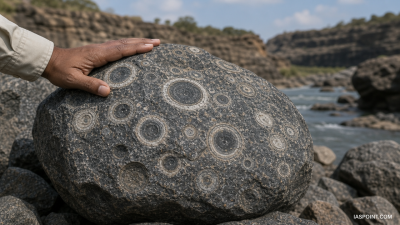
Scientists have dated the Pichhore orbicular granite near Kutawali village, Shivpuri district, Madhya Pradesh to about 2.56 billion years, identifying it as the second-oldest known orbicular rock globally.
Orbicular granite
- Definition: Rare intrusive igneous rock containing orbicules—rounded, concentrically layered bodies within a finer-grained matrix.
- Composition: Orbicules commonly consist of quartz and feldspar with concentric layering.
- Orbicules size: Individual orbicules can reach up to ~30 cm in diameter.
Age and dating
- Age: ~2.56 billion years (Neoarchean; c. 2.8–2.5 Ga).
- Method: Uranium–Lead (U–Pb) zircon geochronology used for crystallisation age determination.
- Inherited zircons: Detected zircons as old as ~3.5 Ga, recording older continental crustal material recycled into the rock.
Geological setting
- Location: Pichhore orbicular granite, near Kutawali village, Shivpuri district, Madhya Pradesh.
- Craton: Occurs within the Bundelkhand Craton, an ancient, stable block of the Indian shield important for Precambrian studies.
Key facts for exams
- Global rank: Second-oldest orbicular rock after a Western Australia occurrence.
- Published in: Geosystems and Geoenvironment (research paper reporting the find).
- Research institutions: Involvement of Banaras Hindu University, IIT Kanpur, IISER Berhampur, University of Campinas (Brazil), and JAIST (Japan).