
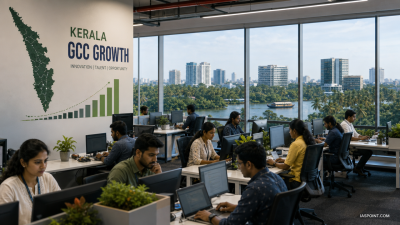
Kerala has set an updated target to host 150 Global Capability Centres (GCCs) and generate about 2 lakh associated jobs by 2031 under the “Kerala GCC Outlook 2026” roadmap. The strategy was introduced at Technopark, Thiruvananthapuram and backed by a feasibility report from ANSR.
What is the current issue
Kerala seeks to expand operational GCCs from about 45 to 150 by 2031. The roadmap names ANSR as feasibility partner. Technopark signed an MoU with Collabera and Infoparks Kerala signed with ANSR to accelerate centre setup and client outreach.
Why it matters
GCC expansion affects employment composition, regional industrial growth, urban infrastructure, R&D capacity and state-level investment competition. Outcomes will shape skill demand, income patterns, real-estate markets, and the state’s role in global technology value chains.
Understanding Global Capability Centres (GCCs)
GCCs are captive units of multinational corporations providing IT, finance, R&D, analytics, AI, HR and customer-support services. In India they range from service-delivery teams to advanced engineering and product-R&D units owned by parent firms.
Drivers of India’s GCC boom
- Talent supply: Large pool of STEM graduates and software engineers.
- Cost arbitrage: Competitive operational and real-estate costs versus Western locations.
- Existing ecosystem: IT parks, service firms, and local vendor networks.
- Tier-2 advantages: Lower attrition and better quality of life in non-metro centres.
Kerala roadmap: policy and institutions
- Targets: 150 GCCs and ~2 lakh jobs by 2031.
- Feasibility partner: ANSR presented the Kerala Feasibility Report 2026.
- MoUs: Technopark–Collabera; Infoparks Kerala–ANSR to catalyse investments and operations.
- Policy posture: State acting as enabler through dedicated parks, single-window facilitation and targeted outreach.
- Previous anchor targets: Earlier documents set alternate numeric targets; the present roadmap is the operative goal.
Macroeconomic and industrial implications
- Value-chain ascent: Movement from low-end outsourcing to engineering, analytics and product design raises average value added per worker.
- Employment quality: Creation of high-skilled, higher-wage jobs increases household incomes and consumption demand.
- Multiplier effects: Boost to commercial real estate, hospitality, transport and local services.
- Distributional risk: Potential widening of wage gaps between tech-skilled workers and other labour groups.
R&D, IP and technological capacity
GCCs can host advanced R&D in AI, cloud, data sciences and product engineering. However, two structural issues persist: most IP remains registered to parent MNCs abroad; and academic curricula often misalign with employer needs. Policy can encourage joint research agreements, co-patenting, and local technology transfer centres to retain greater value domestically.
Governance and competitive federalism
State-level roadmaps exemplify competitive federalism. Kerala’s approach combines infrastructure provision, targeted incentives and collaboration with specialist firms. Effective outcomes require policy continuity, streamlined approvals, and performance-linked incentives. The state’s role shifts from regulator to facilitator of ecosystem actors.
Regional development, social dimensions and urban effects
- Decentralisation: GCCs sited in Tier‑2 cities reduce pressure on major metros and spread growth.
- Brain retention: Local high-value jobs limit out-migration and overseas displacement of talent.
- Gender inclusion: Proximity of jobs can raise female labour-force participation by reducing relocation barriers.
- Urban planning: Demand for housing, public transport and civic utilities will rise; coordinated urban policy is needed.
Key constraints and challenges
| Challenge | Impact |
|---|---|
| Physical infrastructure deficits | Limits plug-and-play office space, international connectivity and employee commute options. |
| Skill mismatch | Constrains placement into advanced roles; raises training costs for firms. |
| IP capture abroad | Reduces domestic innovation ownership and downstream economic benefits. |
| Regulatory and land issues | Delay project delivery and increase setup costs. |
Policy options and operational measures
| Area | Policy response |
|---|---|
| Skills | Industry‑aligned curricula, apprenticeship incentives, certified short-term upskilling programmes with employer co‑funding. |
| Infrastructure | Prioritise high-speed broadband, airport connectivity, dedicated business districts and affordable housing near parks. |
| R&D & IP | Promote co‑patenting, tax credit for local R&D, grant schemes for joint university–GCC projects and technology transfer offices. |
| Governance | Strengthen single-window clearances, time-bound approvals and outcome-linked incentives; monitor employment and local procurement targets. |
Implementation indicators
- Output: Number of operational GCCs, direct jobs created, floor-area occupied in IT parks.
- Quality: Share of R&D roles, average wages, patents filed or co‑filed in India.
- Equity: Female participation rate, regional employment distribution and local procurement by GCCs.
Model Questions
1. Analyse the macroeconomic implications of India’s shift from low-end outsourcing to Global Capability Centres (GCCs) for employment and industrial growth. [GS-III: Economic Development]
GCCs raise value‑added per worker by moving into engineering, analytics and R&D, creating high‑paying skilled jobs and stimulating consumption. They generate multiplier effects in real estate, transport and services. Risks include wage polarisation and regional skill shortages. Policy must target upskilling, support for affected lower‑skilled workers, and infrastructure to sustain industrial clustering and inclusive local growth.
2. Examine how sub‑national initiatives such as state GCC roadmaps influence competitive federalism and FDI attraction in India. [GS-II: Governance]
State roadmaps tailor incentives, infrastructure and talent policies to local strengths, attracting FDI and high‑tech firms. This fosters competitive federalism by decentralising investment promotion and reducing pressure on traditional centres. Success requires policy stability, single‑window clearances and collaboration with specialised partners. Coordination with central schemes and inter‑state best practice exchange improves outcomes.
3. Assess the role of Global Capability Centres in strengthening India’s domestic R&D ecosystem and the obstacles to retaining intellectual property domestically. [GS-III: Science & Technology]
GCCs introduce advanced engineering practices and can drive joint research. Obstacles include parent firms registering IP abroad, weak industry‑academia linkages and skill gaps. Policy responses: incentives for local R&D expenditure, co‑patenting norms, research grants for collaborative projects and technology transfer offices to channel outcomes into Indian institutions and startups.
4. Discuss the potential of GCC proliferation in Tier‑2 and Tier‑3 cities to reduce regional disparities and arrest brain drain. Evaluate socio‑economic trade-offs. [GS-I: Indian Society]
Siting GCCs in smaller cities creates high‑value local jobs, reduces migration pressure on metros and improves regional incomes. It can raise female workforce participation by lowering relocation needs. Trade‑offs include urban infrastructure strain and unequal gains if skills and mobility barriers persist. Complementary measures in transport, housing and local training are necessary for inclusive regional impact.
Last Modified: July 22, 2026