
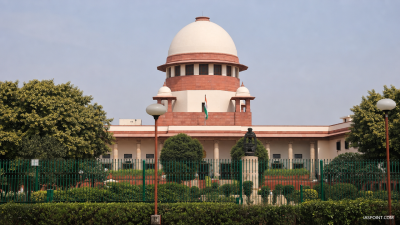
The Supreme Court issued an interim order on 24 July 2026 prohibiting unauthorised posting, extraction, editing, dissemination or monetisation of audio‑video recordings of court proceedings on social and digital platforms without prior permission from the Secretary General of the Supreme Court or the Registrar General of the jurisdictional High Court. The bench comprised Chief Justice Surya Kant, Justice Joymalya Bagchi and Justice V. Mohana; petitioner: Harshita Grover.
What is the issue?
Live‑streaming of judicial hearings has increased public access. Recent practice of clipping, editing and commercialising courtroom audio‑video has produced selective, decontextualised material on platforms. The Supreme Court’s interim direction bars unauthorised extraction, modification, reposting and monetisation of such recordings and seeks responses from the Centre and intermediaries including Meta and X.
Why it matters for governance, law and society
- Rule of law: Decontextualised clips can prejudice ongoing cases and impair fair trial rights under Article 21.
- Judicial dignity: Unchecked circulation risks trivialising judicial process and exposing judges, parties and witnesses to harassment.
- Information ecosystem: Platforms’ algorithmic amplification turns legal debates into viral content, distorting public understanding.
- Policy response: The order requires a regulatory and administrative framework to balance transparency and protection of judicial process.
Constitutional and legal dimensions
Judicial competence: Under Article 124 the Supreme Court governs its procedure and may protect its dignity and administration. Freedom of speech: Article 19(1)(a) guarantees expression; Article 19(2) permits reasonable restrictions including contempt of court and public order. The interim order preserves bona fide news reporting while restricting unauthorised digital modification and monetisation. Fair trial and privacy: Article 21 concerns fair trial and personal dignity. Edited clips can form prejudicial narratives affecting litigants and witnesses. Statutory interface: Section 79 of the IT Act 2000 grants intermediaries safe harbour absent actual knowledge. That provision complicates real‑time liability for platforms hosting clipped or edited judicial content.
Technological and regulatory challenges
- Platform detection limits: Intermediaries face difficulty identifying edited or clipped court content at upload without reliable reference fingerprints.
- Algorithmic amplification: Engagement‑optimised feeds prioritise sensational clips, increasing reach of decontextualised material.
- AI risks: Deepfakes and audio‑video manipulation weaken provenance and verification; automated removal may produce both over‑blocking and under‑enforcement.
- Liability gap: Safe harbour rules, cross‑jurisdictional hosting and end‑to‑end encryption create enforcement friction between courts, government and platforms.
Ethical and institutional implications
- Trivialisation of justice: Editing for clicks converts legal argument into entertainment and erodes public trust in reasoned judgment.
- Chilling effects: Fear of misrepresentation may inhibit judicial candour and robust advocacy.
- Commercial capture: Monetisation of court clips turns a public good—access to justice—into private revenue streams.
- Safety and privacy: Public exposure of parties and witnesses increases risk of harassment and security threats.
Administrative and technical responses — practical measures
- Permission regime: Require express approval from the Secretary General of the Supreme Court or the Registrar General of the relevant High Court for reuse or monetisation of recordings.
- Digital watermarking: Apply secure, dynamic watermarks and metadata to official streams to enable provenance checks and automated takedown.
- Content‑ID systems: Co‑develop platform tools (hashing, fingerprint databases) to block unauthorised uploads at source, modelled on copyright matching systems.
- Nodal coordination: Centre to nominate nodal ministry and define a co‑regulatory framework assigning duties to courts, registries and intermediaries.
- Rapid redress: Empower registries with technical teams to issue expedited takedown notices and preservation orders for violations.
- Guidelines for news media: Clear criteria distinguishing bona fide, fair reporting from edited, monetised clips that distort context.
- Capacity building: Judicial training on digital risks and procedural rules for live‑streaming; platform training on court sensitivity.
Stakeholders, risks and responses
| Stakeholder | Primary risk/interest | Regulatory or technical response |
|---|---|---|
| Supreme Court / High Courts | Preserve decorum, fair trial, institutional reputation | Permission regime; watermarking; registries with technical wings |
| Intermediaries (Meta, X, others) | Content moderation burden; legal exposure | Content‑ID, automated blocking, policy alignment with courts |
| News media | Right to report; editorial freedom | Exemptions for bona fide reporting; transparent credentialing |
| Litigants, witnesses, judges | Privacy, safety, reputational harm | Protected status for sensitive hearings; redaction protocols |
| Public | Access to justice; informed debate | Official streams with contextualisation; summaries by accredited reporters |
Implementation risks and safeguards
- Over‑broad blocking: Risk of curtailing legitimate reporting; mitigate via narrow definitions and accreditation.
- Enforcement lag: Cross‑border hosting can delay takedown; use mutual legal assistance and fast preservation orders.
- Technical arms race: As manipulation tools improve, continuous investment in detection and forensic capacity is needed.
- Transparency and accountability: Publish takedown metrics and a grievance mechanism to prevent misuse of the permission regime.
Model Questions
1. Analyse the tension between the right to information under Article 19(1)(a) and the need to preserve judicial decorum in the context of live‑streaming and sharing of court proceedings. [GS-II: Constitution of India & Polity]
The right to information supports public access and accountability; live‑streaming advances these aims. Restrictions under Article 19(2) and contempt powers permit limiting publication that prejudices fair trial or dignity. Balance requires narrow rules: permit bona fide reporting, prohibit unauthorised extraction, editing and monetisation, enable court permission processes, and ensure procedural safeguards so transparency does not impair impartial adjudication or personal security.
2. Examine regulatory challenges faced by the state and intermediaries under the IT Act in preventing misuse of live‑streamed judicial content and suggest institutional remedies. [GS-III: Science & Technology]
Section 79 safe harbour limits intermediary liability absent actual knowledge, while algorithms prioritise engagement. Challenges include real‑time detection, cross‑border hosting and AI‑generated manipulation. Remedies: co‑regulatory content‑ID systems, dynamic watermarking, nodal ministry coordination, expedited preservation and takedown pipelines, and clarifying intermediary obligations through rules that balance free speech with judicial integrity.
3. Discuss ethical dilemmas arising from commercialisation and decontextualisation of live‑streamed court proceedings. [GS-IV: Ethics, Integrity and Aptitude]
Key dilemmas: converting judicial process into entertainment undermines respect for judicial reasoning; selective clips can mislead public opinion; monetisation of public hearings privatises a civic resource; and misrepresentation risks harm to parties and witnesses. Ethical safeguards include strict limits on monetary use, accreditation for reportage, contextual framing and institutional norms that protect dignity while preserving legitimate transparency.
4. Evaluate the effectiveness of judicial self‑regulation through interim directives in safeguarding the administration of justice. [GS-II: Governance]
Interim directives provide immediate containment by prohibiting unauthorised reuse and requiring court permissions, preserving fairness and dignity. Effectiveness depends on operationalising directives: uniform guidelines across courts, technical watermarking, platform cooperation, defined sanctioning mechanisms, and transparent exemptions for bona fide reporting. Without these operational measures, directives risk limited deterrence and inconsistent enforcement.
Last Modified: July 25, 2026