
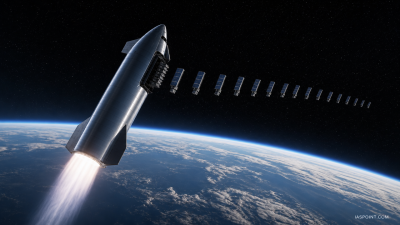
SpaceX launched Starship from Starbase, Texas, on 24 July 2026 for Flight 13; the upper stage deployed 20 Starlink V3 satellites into suborbital trajectories and conducted an in‑space Raptor engine relight test.
Starship System
- Architecture: Two-stage fully reusable system comprising Super Heavy (booster) and Starship (upper stage/payload).
- Super Heavy behaviour: Performed directional flip and boostback; experienced a hard splashdown in the Gulf of Mexico after fewer engines relit than planned during landing burn.
- Starship upper stage behaviour: Completed controlled re‑entry and soft splashdown in the Indian Ocean while transmitting telemetry.
Starlink V3 Satellites
- Number deployed: 20 upgraded V3 satellites released during the flight.
- Payload features: V3 is designed for higher bandwidth and faster user speeds; six satellites carried cameras to relay live views.
- Trajectory and fate: Deployed on suborbital trajectories and configured to re‑enter and burn up after data collection.
Test Objectives and Key Technology
- Raptor relight test: In‑space engine restart assessment of the liquid‑methane/liquid‑oxygen Raptor.
- Propulsion cycle: Raptor uses a full‑flow staged combustion cycle with methalox propellants.
- Telemetry: Remote transmission of spacecraft data to ground stations during descent and splashdown.
- Suborbital definition: Reaches space without completing an orbital revolution around Earth.
IASPOINT Booster Facts
- Launch site: Starbase (Boca Chica), Texas is SpaceX’s primary Starship test facility.
- Mission count: Flight 13 denotes the 13th full test flight of the Starship programme.
- Starlink operator: Satellite internet constellation operated by SpaceX for global broadband coverage.
- Reusability aim: Starship programme targets rapid turnaround heavy‑lift capability for orbital, lunar and deep‑space missions.