
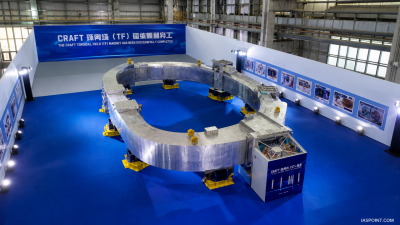
On 27 June 2026 China completed expert acceptance and full‑parameter testing of two domestically developed superconducting magnets at the Institute of Plasma Physics, Chinese Academy of Sciences (Hefei, Anhui). Systems tested were a toroidal field superconducting magnet and a high‑temperature superconducting central solenoid coil for fusion research.
The Two Magnet Systems
- Toroidal Field Magnet: D‑shaped structure; 21 metres long, 12 metres wide, 582 tonnes. Provides the toroidal confining magnetic field in a tokamak.
- Stored Energy Comparison: Has ~1.3× the volume and ~3× the stored magnetic energy of comparable ITER toroidal magnets.
- Central Solenoid (HTS): High‑temperature superconducting coil that induces and drives plasma current in tokamak operation.
- Full‑parameter Testing: Both systems completed integrated, full‑parameter tests and met design acceptance at IPP‑CAS.
Manufacturing and Programme Linkages
- Domestic Supply Chain: Reported 100% domestic production of core materials and fabrication.
- CRAFT: Project linked to the Comprehensive Research Facility for Fusion Technology (CRAFT) within China’s “artificial sun” programme.
- Timeline: China’s stated target horizon for fusion power generation is around 2030.
Technical & Exam Facts
- Fusion: Nuclear process combining light nuclei to release energy; powers stars.
- Tokamak: Toroidal magnetic‑confinement device; uses toroidal field coils and a central solenoid.
- Superconducting Magnet: Carries large currents with negligible resistance when cooled below critical temperature.
- HTS: High‑temperature superconductors remain superconducting at higher temperatures than conventional low‑temperature types.
- ITER: International thermonuclear experimental reactor located in France; members include EU, China, India, Japan, Korea, Russia, USA.