
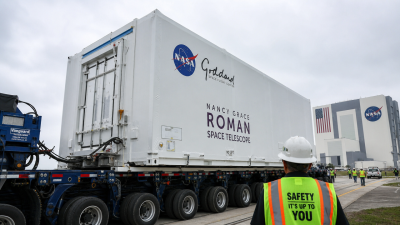
On 21 June 2026 the Nancy Grace Roman Space Telescope arrived at Kennedy Space Center for final pre-launch processing ahead of a targeted launch no earlier than 30 August 2026.
Mission status and timeline
- Arrival: Reached KSC from Goddard on 21 June 2026 via NASA barge.
- Launch window: Targeted for no earlier than 30 August 2026 from Launch Complex 39A on a SpaceX Falcon Heavy.
- Schedule change: Target date is about eight weeks earlier than the original plan.
- Pre-launch processing: About 70 days at KSC for solar‑panel checks, insulation inspection and propellant loading.
- Propellant: Approximately 1,100 litres of hypergolic hydrazine to be loaded for manoeuvres and stationkeeping.
Spacecraft and instruments
- Mass: Roughly 8,200 kg.
- Primary mirror: 2.4‑metre aperture.
- Wide Field Instrument: 300‑megapixel camera with a field of view at least 100 times that of Hubble.
- Power: Six solar panels provide electrical power.
- Cost and class: USD 4.3 billion; NASA flagship astrophysics mission after the James Webb Space Telescope.
Science objectives and orbit
- Primary goals: Wide‑field infrared surveys targeting dark energy, dark matter and exoplanet detection.
- Operational orbit: Will operate near the Sun–Earth Lagrange point L2, about 1 million miles (1.6 million kilometres) beyond Earth.
- Mission life: Designed for ten years or more, limited by available propellant and hardware lifetime.
IASPOINT Booster Facts
- L2 usage: Sun–Earth L2 provides a stable thermal and viewing environment; JWST also operates from L2.
- Hydrazine: Monopropellant commonly used for spacecraft attitude control and orbital corrections.
- Falcon Heavy: Heavy‑lift launcher capable of delivering large payloads to translunar and Lagrange trajectories from LC‑39A.