
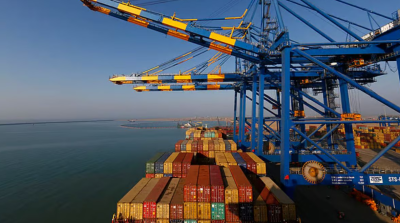
The Department of Financial Services under the Ministry of Finance launched the Bharat Maritime Insurance Pool (BMIP) in New Delhi on 12 May 2026. Approved by the Union Cabinet in April 2026, this sovereign-backed domestic insurance mechanism protects Indian maritime trade from rising geopolitical volatility and insurance disruptions, particularly due to conflicts in West Asia. Operating with a total capacity of 1.5 billion United States dollars, the pool provides alternative risk management to reduce Indian dependency on international insurance conglomerates. The initiative ensures trade continuity for domestic vessels transiting high-risk maritime channels like the Red Sea and Persian Gulf.
Institutional Framework and Financial Structure
The BMIP operates as a multi-tiered public-private risk-sharing network backed directly by the central government.
Sovereign Guarantee Backstop
The Government of India provides a structural financial guarantee worth 1.4 billion United States dollars, equivalent to ₹12,980 crore. This sovereign allocation acts as a contingent backstop of last resort for extreme or catastrophic losses in international waters.
Dual-Tiered Claim Settlement
The pool handles financial claims through a clear, two-stage mechanism to ensure systemic liquidity during crises:
Tier 1 Settlements
Claims arising up to 100 million United States dollars are fully processed using the pool’s internal resources. This initial capital consists of accumulated reserves, commercial premiums, and co-insurance contributions from member companies. The initial combined underwriting capacity stands at approximately ₹950 crore.
Tier 2 Settlements
For catastrophic claims exceeding 100 million United States dollars, the sovereign guarantee is formally invoked. This reserve is accessed only after the complete exhaustion of the pool’s active reserves, member contributions, and standard reinsurance channels.
Nodal Administration
The state-owned reinsurance enterprise, General Insurance Corporation of India (GIC Re), acts as the pool administrator. GIC Re is responsible for submitting operational performance statements, coordinating reinsurance distributions, and monitoring fund allocations. A dedicated Governing Body oversees the invocation of the sovereign guarantee, while a separate Underwriting Committee handles risk assessment and pricing structures.
Core Insurance Coverage Categories
The platform aggregates multiple risk components into a single-window underwriting model tailored to modern naval vulnerabilities.
Hull and Machinery Insurance
This segment covers physical damage or total structural loss of the ship’s hull, internal machinery, propulsion systems, and on-board electronic navigation tools caused by maritime accidents or structural stress.
Cargo Insurance
This coverage protects commercial goods, raw commodities, and manufactured items in transit from international origins to Indian ports or vice-versa. It insulates domestic exporters from financial losses during deep-sea transport.
Protection and Indemnity (P&I)
This handles non-contact third-party liabilities that standard hull policies exclude. Covered risks include marine oil pollution penalties, vessel wreck removal costs, cargo damage claims, crew injury compensation, and mandatory repatriation expenses.
War Risk Insurance
This specialized insurance covers physical damage and operation liabilities triggered by hostile acts in designated conflict zones. It secures vessels against drone strikes, piracy, naval missile attacks, sea mines, and localized geopolitical sanctions.
Strategic Implications for Trade and Security
Shifting from foreign maritime underwriting markets to a domestic framework alters India’s global trade position.
Sanctions Resilience and Sovereignty
International groups often withdraw insurance support from ships entering specific trade zones to comply with unilateral Western sanctions. A state-backed domestic pool allows India to maintain independent trade supply chains for critical energy and commodity imports during geopolitical standoffs.
Elimination of Premium Volatility
Geopolitical friction in maritime choke points like the Strait of Hormuz typically leads to sharp, unexpected premium increases by foreign underwriters. The BMIP stabilizes insurance costs, protecting Indian shipping lines and retail consumers from sudden freight price spikes.
Conservation of Foreign Exchange
Indian ship owners previously paid significant premium volumes to foreign insurance pools and clubs. Keeping these risk-management procedures within domestic companies retains capital inside the local financial system and supports specialized marine underwriting careers in India.
IASPOINT Booster Facts for UPSC
- Eligibility Rules: The pool covers Indian-flagged vessels, Indian-controlled ships, and international vessels moving cargo directly to or from Indian ports.
- Operational Timeline: The framework is established for an initial period of 10 years, with an option for a 5-year extension based on review.
- Historical Policy Milestone: The New India Assurance Company Limited issued the first Marine Hull and Machinery War Policy under this pool to Hoger Offshore and Marine Private Limited.
- Cargo Policy Pioneers: Vedanta Sterlite Copper Limited and Balrampur Chini Mills Limited were the first commercial entities to receive Marine Cargo War Policies under the new domestic framework.
- The P&I Club Deficit: India was historically the only major maritime nation without a domestic Protection and Indemnity club, making local operators fully reliant on the International Group of P&I Clubs (IGP&I) based in Europe.
- Maritime Fleet Scale: India’s commercial fleet consists of roughly 1,549 ships, accounting for about 1.2% of the total global shipping fleet by volume.
- Trade Dependence: Over 70% of India’s international trade by volume and nearly 95% by value moves through maritime transport routes.
- Policy Integration: The development of domestic maritime financial networks aligns with the long-term goals of the Maritime India Vision 2030 and the broader national strategy of Sagarmala for port-led development.