
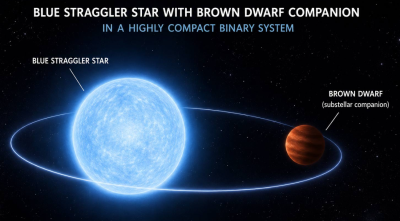
Indian astrophysicists, in collaboration with Italian researchers, have discovered the world’s first confirmed blue straggler star hosting a brown dwarf companion. This rare celestial pairing forms an ultra-compact binary system with an exceptionally short orbital period of just 5.6 hours. The discovery, published in the Monthly Notices of the Royal Astronomical Society, identifies the lightest companion ever detected around a blue straggler. Located in the old open star cluster NGC 7789, this breakthrough offers new insights into stellar evolution, mass-transfer mechanisms, and the formation pathways of atypical star systems.
Understanding the Celestial Components
Blue Straggler Stars
Blue stragglers are old stars that appear younger, hotter, and bluer than they should be according to standard stellar evolution theories. In a star cluster, all stars form at roughly the same time. Over time, massive stars burn through their hydrogen fuel quickly and evolve off the main sequence. Blue stragglers defy this timeline. They track leftward and upward into the hotter main-sequence region of a Hertzsprung-Russell diagram because they acquire extra mass from a companion star, effectively rejuvenating their nuclear fuel supply.
Brown Dwarfs and the Desert
Brown dwarfs occupy a transitional mass range between giant gas planets and low-mass stars. They have a mass between 13 and 80 times that of Jupiter. This mass is insufficient to trigger sustained hydrogen fusion in their cores, earning them the nickname “failed stars.” Systems where a star and a brown dwarf orbit closely are rare. Astronomers call this phenomenon the “brown dwarf desert,” as standard planetary and stellar formation processes rarely produce close-in brown dwarf companions.
Discovery Mechanics and Orbital Dynamics
Observational Infrastructure
The research team identified the binary system by analyzing data from multiple advanced astronomical instruments. They used the Ultra-Violet Imaging Telescope (UVIT) aboard AstroSat, India’s first dedicated multi-wavelength space observatory. The team supplemented these space observations with high-resolution ground spectroscopy from the Telescopio Nazionale Galileo in La Palma, Spain, to measure precise radial velocity shifts.
Key System Parameters
The newly discovered binary system breaks several astrophysical records regarding its mass ratio and orbital tightness.
- Host Star: A rejuvenated blue straggler star situated in the galactic open cluster NGC 7789.
- Companion Mass: Less than 0.08 times the mass of the Sun, placing it firmly below the hydrogen-burning limit.
- Orbital Period: Approximately 5.6 hours, making it one of the shortest orbital configurations recorded for an evolved binary system.
- System Nature: Ultra-compact binary system experiencing extreme gravitational interaction.
Implications for Stellar Evolution Models
Formation Pathways of Blue Stragglers
Astrophysicists recognize two primary pathways for blue straggler formation: direct stellar collisions in dense environments or stable mass transfer between binary pairs. This discovery supports the mass-transfer model, often called the “vampire star” scenario. The progenitor star stripped gas away from its companion, growing more massive and luminous while stripping the companion down to its core.
Redefining Binary Mass Limits
Standard astronomical models assume that mass transfer in an ultra-compact binary eventually destroys low-mass companions or causes the system to merge. Finding a surviving brown dwarf with an ultra-short orbital period proves that these low-mass objects can endure the intense gravitational stripping process. This requires scientists to update current computational simulations regarding binary angular momentum loss and common-envelope evolution phases.
Comparative Profile of Substellar and Stellar Companions
| Object Classification | Typical Mass Range | Core Fusion Process | Common Observational Settings |
| Gas Giant Planet | Less than 13 Jupiter Masses | No nuclear fusion | Planetary systems around main-sequence stars |
| Brown Dwarf | 13 to 80 Jupiter Masses | Deuterium fusion only | Isolated space or wide binary systems |
| Low-Mass Red Dwarf | 0.08 to 0.5 Solar Masses | Sustained hydrogen fusion | Dominant population in galactic disks |
| Blue Straggler Star | Varies (Greater than cluster turnoff mass) | Accelerated hydrogen fusion | Globular clusters and old open clusters |
IASPOINT Booster Facts for UPSC
- AstroSat Mission Profile: Launched in 2015 by the Indian Space Research Organisation (ISRO) via a PSLV vehicle, AstroSat is India’s premier space observatory capable of simultaneous observations in ultraviolet, optical, and X-ray bands.
- NGC 7789 Open Cluster: Discovered by Caroline Herschel in 1783, this cluster is located in the Cassiopeia constellation. It is often called “The White Rose” or “Caroline’s Rose” due to the loops of stars resembling petals.
- Hertzsprung-Russell (H-R) Diagram: This scatter graph plots stars by their luminosity versus their color temperature. Blue stragglers occupy a distinct, anomalous position above and to the left of the cluster’s main-sequence turnoff point.
- The Hydrogen-Burning Limit: This boundary stands at roughly 0.075 to 0.080 solar masses. Objects above this threshold become true stars, while objects below it cannot maintain core temperatures high enough for regular hydrogen fusion.
- Collaborating Institutions: The discovery involved key contributions from the Indian Institute of Astrophysics (IIA), Bengaluru, along with researchers from IUCAA Pune and the Italian National Institute for Astrophysics (INAF).