
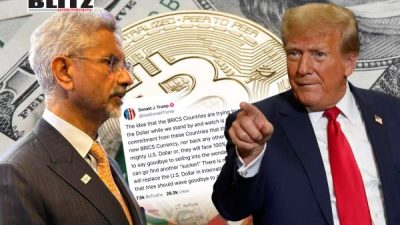
The global financial landscape is experiencing shifts as countries explore alternatives to the US dollar in international trade. The BRICS nations, comprising Brazil, Russia, India, China, South Africa, Egypt, Iran, Ethiopia, and the United Arab Emirates, are advocating for local currency trading. This movement has gained momentum since the onset of the Russia-Ukraine war in 2022, with Russia leading the charge for de-dollarisation. Recently, Donald J. Trump, the US President-elect, threatened to impose 100% tariffs on BRICS nations if they continue to pursue this strategy.
About De-dollarisation
De-dollarisation refers to the process of reducing reliance on the US dollar for international trade and finance. Many countries aim to mitigate risks associated with dollar dependence, especially in light of sanctions imposed by the United States. The BRICS nations are particularly focused on enhancing trade in local currencies to promote economic independence.
Current Global Currency Reserves
As of the second quarter of 2024, US dollars account for approximately 58% of global foreign exchange reserves, totalling around $12.3 trillion. This marks the dollar’s dominance as a reserve currency. Other currencies include the Euro, British Pound, Japanese Yen, and Australian Dollar. The Chinese renminbi, despite being the seventh most held currency, represents only 2.14% of global reserves.
Impact of US Sanctions
US sanctions have led to challenges for countries that find trading in dollars increasingly difficult. Nations affected by sanctions often seek alternatives to the dollar to facilitate trade. This has prompted discussions around local currency transactions among BRICS members as a strategy to navigate economic pressures.
BRICS and Local Currency Financing
At the recent Kazan summit, BRICS leaders emphasised the importance of local currency financing. The New Development Bank (NDB) was tasked with expanding local currency financing mechanisms. The summit’s declaration did not explicitly mention de-dollarisation but brought into light the need for efficient and inclusive cross-border payment systems.
Challenges Ahead for BRICS
Despite the push for de-dollarisation, challenges remain. The limited global acceptance of the Chinese renminbi hampers efforts to establish a new currency alternative. Furthermore, the historical dominance of the US dollar poses barrier to the success of local currency initiatives among BRICS nations.
Future of International Trade
The ongoing tensions surrounding currency usage will shape the future of international trade. The US’s response to de-dollarisation efforts will be crucial. Countries will need to navigate the complexities of economic independence while managing relationships with major powers like the United States.
Questions for UPSC:
- Critically discuss the implications of de-dollarisation for global trade dynamics.
- Examine the role of the New Development Bank in enhancing local currency financing among BRICS nations.
- Point out the challenges faced by the Chinese renminbi in becoming a dominant global currency.
- Analyse the impact of US sanctions on the economic strategies of countries within the BRICS grouping.
Answer Hints:
1. Critically discuss the implications of de-dollarisation for global trade dynamics.
- De-dollarisation aims to reduce reliance on the US dollar, enhancing economic independence for countries.
- It could lead to increased trade in local currencies, potentially reshaping international trade agreements.
- Countries may create alternative payment systems, challenging the dollar’s dominance in global finance.
- De-dollarisation can provoke economic tensions, especially with the US, which may respond with tariffs or sanctions.
- Long-term effects may include a multipolar currency system, affecting global economic stability and growth.
2. Examine the role of the New Development Bank in enhancing local currency financing among BRICS nations.
- The New Development Bank (NDB) was established to support infrastructure and sustainable development projects in BRICS countries.
- At the Kazan summit, the NDB was tasked with expanding mechanisms for local currency financing.
- Local currency financing can mitigate exchange rate risks and promote trade among BRICS nations.
- The NDB aims to enhance financial cooperation and reduce transaction costs in cross-border trade.
- By facilitating local currency transactions, the NDB supports the broader goal of de-dollarisation among its member states.
3. Point out the challenges faced by the Chinese renminbi in becoming a dominant global currency.
- The Chinese renminbi accounts for only 2.14% of global foreign reserves, indicating limited international acceptance.
- Concerns over China’s economic policies and transparency hinder confidence in the renminbi as a reserve currency.
- The lack of a fully convertible currency restricts its use in global trade and finance.
- Geopolitical tensions and trade disputes may further impede the renminbi’s growth as a dominant currency.
- BRICS nations face difficulties in establishing a unified currency alternative due to varying economic strengths and policies.
4. Analyse the impact of US sanctions on the economic strategies of countries within the BRICS grouping.
- US sanctions limit access to dollar-denominated transactions, prompting BRICS nations to seek alternatives.
- Countries affected by sanctions face challenges in international trade, necessitating local currency arrangements.
- Sanctions can lead to economic isolation, pushing countries to strengthen ties within the BRICS framework.
- BRICS nations may adopt strategies to circumvent sanctions, encouraging a more collaborative economic environment.
- Long-term, sanctions could drive BRICS towards greater autonomy and a collective stance against US economic dominance.