
Daily Activities

UPSC Prelims Current Affairs

UPSC Mains Current Affairs

Current Affairs

BRICS Cities and Urbanisation Forum 2026

BRICS Cities and Urbanisation Forum 2026

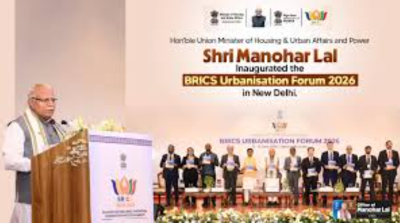
The 13th BRICS Urbanisation Forum commenced in New Delhi under India’s BRICS Chairship in 2026, bringing together ministers, senior government officials, and urban experts from BRICS and partner countries to discuss inclusive and resilient urban development. Formally inaugurated at Sushma Swaraj Bhavan by Union Housing and Urban Affairs Minister Manohar Lal, the two-day forum focused on the theme “Cities for People: BRICS Cooperation for Inclusive and Resilient Urban Futures,” guided by the vision of “Humanity First.” The event served as a major platform to integrate the urban sustainability agenda into global development conversations, featuring high-level plenaries, the release of a landmark publication on India’s urban transformation, and critical bilateral meetings to strengthen international urban governance.

Institutional Structure and Regional Footprint

The BRICS Urbanisation Forum acts as the dedicated ministerial and professional platform within the broader BRICS framework to deliberate on urban policy, identify joint developmental priorities, and manage rapid demographic transitions across member states.

Expanded Membership Dynamics

The 2026 forum reflects the expanded BRICS operational framework. High-level delegations and urban practitioners participated from ten key member states, demonstrating the growing geopolitical reach of the bloc:

  • Founder and Core States: Brazil, Russia, India, China, and South Africa.
  • Expanded Member Blocs: Egypt, Ethiopia, Iran, the United Arab Emirates, and Indonesia.
India’s Hosting Legacy

The 2026 event marks the fourth time India has hosted this urban cooperative forum. The hosting sequence tracks the steady evolution of India’s urban development narrative over the past decade:

  • 2013: First Forum held in New Delhi, establishing the baseline framework for intra-bloc urban dialogue.
  • 2016: Second physical edition hosted in Visakhapatnam, focusing on smart city architectures.
  • 2021: A virtual session managed during global travel constraints.
  • 2026: Thirteenth edition hosted in New Delhi, integrating the expanded member ecosystem under India’s chairship theme: “Building for Resilience, Innovation, Cooperation and Sustainability.”

Strategic Core Pillars of the Forum

The deliberations and technical panels were organized around four distinct priority areas designed to address structural deficiencies in modern expanding cities.

Climate- and Disaster-Resilient Urban Infrastructure

With rapid climate shifts triggering frequent urban flooding and extreme heat stress, discussions centered on upgrading municipal infrastructure. The focus areas combined green and grey engineering solutions to ensure that public transit systems, housing stocks, and drainage networks can absorb, recover from, and adapt to climate shocks.

Digital Innovation for Urban Governance

Delegates evaluated digital intervention tools to optimize municipal service delivery. Key themes included utilizing geographic information systems (GIS) for property tax mapping, implementing IoT-enabled public utility monitoring, and deploying integrated command and control centers to manage urban traffic and emergency responses.

Strengthening Municipal Institutions and Urban Finance

Recognizing that global mandates fail without local implementation capacity, the forum prioritized structural reforms for Urban Local Bodies (ULBs). This includes diversifying urban finance instruments, municipal bond market deployment, and training municipal cadres to improve local revenue generation and service delivery.

Inclusive Urban Development

Ensuring equitable access to affordable housing, potable water, and sanitation facilities for marginalized urban populations remained a central anchor, aligning with sustainable development goals.

Bilateral Diplomatic Sidelines

The forum served as a space for fast-tracking targeted bilateral agreements on urban governance and construction technologies.

Bilateral Dialogue TrackCo-Chairing DignitariesCore Area of Policy Finalization
India – Russian FederationMoS MoHUA Tokhan Sahu & Russian Deputy Minister Yury MutsenekFinalizing the Memorandum of Understanding (MoU) on Sustainable Urban Development, covering affordable housing and sustainable construction.
Iran – Russian FederationSenior Urban Planning SecretariatsMunicipal infrastructure cooperation and technical capacity building.
Iran – ChinaAdministrative Municipal HeadsExchange of smart city governance frameworks and public transit technologies.
Russia – United Arab EmiratesTechnical Construction DelegationsGreen building technologies and sustainable construction materials.

On-Field Validation and Publications

The host nation combined policy discussions with data-driven publications and field exposures to showcase domestic urban transformations.

India’s Urban Transformation: Stories of Change

During the inaugural session, Union Minister Manohar Lal released this official publication. The document compiles successful, scalable urban practices and case studies submitted by various Indian States and Union Territories, providing an operational template for other developing BRICS economies facing similar urbanization pressures.

Curated Field Expositions

To provide first-hand exposure to modern Indian design and infrastructure execution, delegates undertook guided site visits to major urban interventions in the National Capital Region. These included the newly completed New Parliament Complex and the integrated India Gate–Kartavya Path precinct, highlighting large-scale civic area rejuvenation.

IASPOINT Booster Facts for UPSC

  • Urban Demographic Projections: According to World Bank assessments updated for 2025-26, approximately 40% of India’s population resides in urban areas, a metric projected to scale to nearly 50% by 2047, reinforcing the need for resilient infrastructure.
  • Nodal Domestic Ministry: The apex coordinating agency for the forum within India is the Ministry of Housing and Urban Affairs (MoHUA), which manages national urban flagship missions like AMRUT 2.0, Smart Cities Mission, PMAY-Urban, and SBM-Urban.
  • The Concept of Humanity First: The 2026 forum’s emphasis on human-centric urban design aligns directly with the “Humanity First” vision championed in India’s global diplomatic framework.
  • Urban Heat Island Mitigation: Technical working groups at the forum emphasized deploying cool roofs and urban micro-forestry (Miyawaki methodology) as essential interventions to counter the Urban Heat Island (UHI) effect across BRICS mega-cities.
  • The New Development Bank (NDB) Interface: Recommendations from the Urbanisation Forum directly feed policy inputs into the NDB (formerly the BRICS Development Bank) to guide priority sector lending for sustainable municipal infrastructure projects.
Last Modified: June 12, 2026

Leave a Reply

Your email address will not be published. Required fields are marked *

Archives