
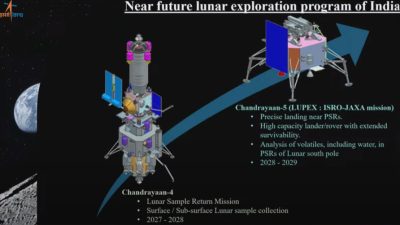
The Indian Space Research Organisation (ISRO) has received approval for the Chandrayaan-5 mission. This decision was announced by ISRO Chairman V Narayanan on March 16, 2025. The mission aims to enhance lunar studies . It will carry a 250 kg rover to investigate the Moon’s surface. This is a substantial increase from the 25 kg rover used in the previous Chandrayaan-3 mission.
Chandrayaan Missions
Chandrayaan-1 was launched in 2008. It successfully created chemical, mineralogical, and photo-geologic maps of the Moon. Chandrayaan-2 followed in 2019. This mission faced challenges when its lander crashed on the lunar surface. However, the orbiter provided valuable high-resolution images. Chandrayaan-3, launched in 2023, successfully soft-landed on the Moon’s south pole. This mission demonstrated ISRO’s capabilities in safe lunar landing and surface exploration.
Chandrayaan-5 Mission Details
Chandrayaan-5 will focus on advanced lunar studies. The mission is a collaborative effort with Japan. The 250 kg rover will enable extensive analysis of the Moon’s surface. This mission aims to build on the successes and lessons from previous missions. It is a step towards deeper understanding of lunar geology and potential resources.
Future Missions and Goals
ISRO has ambitious plans beyond Chandrayaan-5. The Chandrayaan-4 mission is expected to launch in 2027. It will focus on collecting lunar soil samples for return to Earth. This will provide new vital information about the Moon’s composition. Additionally, ISRO is working on the Gaganyaan project, aimed at sending humans into space. Plans are also underway for India’s own space station, the Bharatiya Antariksh Station.
Significance of Lunar Exploration
Lunar exploration is crucial for scientific advancement. It helps in understanding planetary formation and evolution. The Moon serves as a platform for testing new technologies. Furthermore, it may hold resources for future space missions. The Chandrayaan missions contribute to global space exploration efforts.
International Collaboration
The collaboration with Japan for Chandrayaan-5 signifies a growing trend in international space partnerships. Such collaborations enhance technological exchange and share the burden of research costs. They also encourage goodwill and cooperation among nations in space exploration.
Challenges and Opportunities
ISRO faces challenges in lunar exploration. Technical failures, like the Chandrayaan-2 lander crash, highlight risks involved. However, each mission provides valuable data and experience. The opportunity to learn from these challenges strengthens ISRO’s future missions.
Questions for UPSC:
- Critically analyse the impact of lunar exploration on scientific research and technological advancements.
- What are the key objectives of the Chandrayaan-4 mission? How do they differ from previous missions?
- Explain the significance of international collaborations in space exploration. Provide suitable examples.
- What is the role of the Bharatiya Antariksh Station in India’s space strategy? Discuss its potential benefits.
Answer Hints:
1. Critically analyse the impact of lunar exploration on scientific research and technological advancements.
- Lunar exploration enhances understanding of planetary formation and evolution.
- It leads to the development of new technologies, including robotics and remote sensing.
- Data from lunar missions contributes to advancements in materials science and engineering.
- Successes and failures in lunar missions provide critical learning experiences for future space endeavors.
- Research from lunar exploration has implications for Earth sciences and resource management.
2. What are the key objectives of the Chandrayaan-4 mission? How do they differ from previous missions?
- Chandrayaan-4 aims to collect and return lunar soil samples to Earth for analysis.
- This mission focuses on direct sample return, unlike previous missions that primarily conducted remote analysis.
- It seeks to enhance understanding of the Moon’s geological composition and history.
- Chandrayaan-4 will utilize advanced technology for sample collection and return.
- It represents a shift from exploration to hands-on scientific research on lunar materials.
3. Explain the significance of international collaborations in space exploration. Provide suitable examples.
- International collaborations enhance resource sharing, reducing costs for participating nations.
- They facilitate technological exchange, improving mission outcomes through shared expertise.
- Collaborations encourage goodwill and strengthen diplomatic ties, exemplified by ISRO and Japan’s partnership on Chandrayaan-5.
- Joint missions, like the International Space Station (ISS), demonstrate the benefits of collaborative research in space.
- Such partnerships can lead to more ambitious projects and advancements in global space exploration efforts.
4. What is the role of the Bharatiya Antariksh Station in India’s space strategy? Discuss its potential benefits.
- The Bharatiya Antariksh Station aims to establish India’s presence in low Earth orbit.
- It will serve as a hub for scientific research, technology development, and human spaceflight.
- The station can facilitate international collaboration in space research and exploration.
- It will enable long-term missions, enhancing India’s capabilities in space technology.
- Establishing a space station positions India as a key player in the global space arena.