
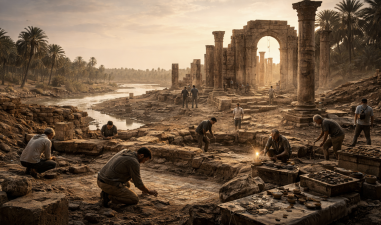
Deep in the deserts of southern Iraq, archaeologists have digitally rediscovered the long-lost city of Charax Spasinou — a major Hellenistic settlement founded in the final years of Alexander the Great’s life. Once a thriving trade hub at the junction of key river routes in Mesopotamia, the city had vanished under centuries of sediment and shifting river courses. Today, cutting-edge technology has brought it back into view, reshaping our understanding of ancient urban networks in West Asia.
The Strategic Vision Behind the City
4
Charax Spasinou was reportedly founded around 324 BCE, near the end of Alexander the Great’s campaigns. The settlement was initially called Alexandria, reflecting Alexander’s pattern of establishing cities to consolidate imperial control.
Its location near the Tigris River and close to the Persian Gulf made it strategically valuable. The city functioned as:
- A military outpost to secure Mesopotamia.
- A commercial gateway linking inland Mesopotamia with maritime trade routes.
- A political symbol of Hellenistic authority in a culturally diverse region.
Over time, floods and conflicts damaged the settlement. It was later rebuilt and renamed Charax Spasinou under a regional ruler, highlighting how cities in antiquity often evolved through cycles of destruction and renewal.
Why the Location Mattered in Ancient Trade
4
Mesopotamia’s rivers were its highways. Situated at a confluence of waterways, Charax Spasinou occupied a commercial sweet spot.
The city connected:
- Overland caravan routes from the Mediterranean.
- Riverine transport along the Tigris and Euphrates.
- Maritime trade networks reaching Arabia and possibly India.
This positioning enabled it to flourish as a customs and redistribution centre. Archaeological evidence of workshops and kilns suggests not only trade but also local manufacturing, reinforcing its economic centrality.
Technology Unlocks a Buried Landscape
4
Unlike traditional excavations, the rediscovery did not rely on large-scale digging. Instead, archaeologists employed:
- Drone-based aerial photography capturing thousands of high-resolution images.
- Magnetometer surveys detecting buried walls and structures beneath the soil.
- Digital modelling to reconstruct the city’s layout.
The result is a detailed virtual map revealing wide streets, expansive housing blocks, temples, and industrial zones. This non-invasive approach preserves the site while enabling large-scale spatial analysis.
Rethinking Urban Scale in the Hellenistic World
Preliminary digital mapping indicates that Charax Spasinou was larger than previously assumed. Archaeologists surveyed an area spanning hundreds of square kilometres, documenting pottery shards, bricks, and industrial debris scattered across the landscape.
This suggests:
- A complex and possibly multi-layered urban structure.
- Sustained habitation over centuries.
- A more integrated economic role within the Hellenistic and later Parthian systems.
The scale challenges earlier assumptions that many of Alexander’s cities were short-lived or purely symbolic foundations.
Environmental Forces and Urban Fragility
The city’s disappearance underscores the vulnerability of ancient settlements to environmental change. Flooding, river course shifts, and political instability contributed to its decline.
Mesopotamia’s dynamic hydrology often reshaped urban landscapes. Cities that thrived on rivers could just as easily be erased by them. Charax Spasinou’s burial under sediment is a reminder that environmental change has long influenced geopolitical geography.
Broader Implications for Ancient History
The rediscovery has implications beyond archaeology:
- It deepens understanding of Hellenistic urban planning in West Asia.
- It highlights the fusion of Greek and Mesopotamian cultural influences.
- It demonstrates how non-invasive technologies are transforming heritage research.
- It may alter interpretations of trade flows between the Mediterranean and the Indian Ocean.
As digital archaeology advances, many more “lost” cities may re-emerge from beneath deserts, forests, and riverbeds.
What to Note for Prelims?
- Charax Spasinou – ancient city in southern Iraq near the Tigris River.
- Founded around 324 BCE, initially named Alexandria.
- Associated with Alexander the Great’s eastern expansion.
- Rediscovered using drone surveys and magnetometer technology.
- Located near strategic Mesopotamian trade routes.
What to Note for Mains?
- Role of urban foundations in imperial consolidation.
- Trade networks linking the Mediterranean, West Asia, and South Asia.
- Environmental determinism in ancient urban decline.
- Impact of digital archaeology on rewriting historical narratives.
- Interplay between geography and geopolitics in ancient civilisations.