
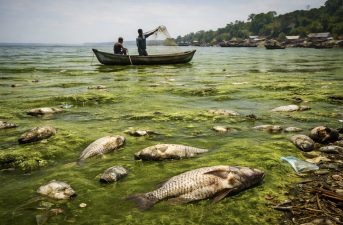
The waters of Lake Victoria — the world’s largest tropical lake — have turned a persistent toxic green, signalling a deep ecological crisis that scientists warn may have crossed a point of no easy return. What began as seasonal algal blooms has now hardened into a semi-permanent condition, threatening drinking water, fisheries, and livelihoods for nearly 47 million people across East Africa. The unfolding transformation is not merely environmental; it is economic, social, and geopolitical.
Lake Victoria: Lifeline of East Africa
4
Lake Victoria spans Kenya, Tanzania, and Uganda, forming the heart of the East African inland fisheries economy. Its basin covers nearly 193,000 square kilometres across five countries, making it both hydrologically vast and demographically pressured.
The lake:
- Supports Africa’s largest inland fishery.
- Provides drinking water and irrigation.
- Acts as a transport and trade corridor.
- Sustains export industries worth hundreds of millions of dollars annually.
Yet, the lake’s colour — once blue — now reflects a structural ecological imbalance.
How Nutrient Pollution Triggered Toxic Blooms
The green hue stems from harmful algal blooms caused by eutrophication — a process in which excess nutrients, primarily nitrogen and phosphorus, stimulate explosive cyanobacterial growth.
Major nutrient sources include:
- Untreated domestic and industrial sewage.
- Agricultural runoff rich in fertilizers and manure.
- Soil erosion and sediment transport during heavy rainfall.
- Rapid urbanisation around riparian towns such as Kisumu.
Wet seasons intensify the crisis. Rivers such as the Nzoia and Nyando deliver massive nutrient loads into the lake during peak rainfall months. Scientific monitoring has documented nitrate discharges reaching tens of thousands of kilograms per day during the monsoon-like wet season.
The process mirrors patterns described by the National Oceanic and Atmospheric Administration in its framework on eutrophication: nutrient enrichment → algal bloom → oxygen depletion → fish mortality.
Reading a Century of Ecological Change
4
Sediment core studies from the Mwanza Gulf reveal that anthropogenic eutrophication began as early as the 1920s, coinciding with land-use intensification in the basin.
Key turning points include:
- 1920–1990: Gradual rise in photosynthetic pigments indicating increasing primary productivity.
- 1960s: Abrupt decline in cladoceran zooplankton biomass.
- 1980s onward: Collapse of haplochromine cichlid populations and cyanobacterial dominance.
The ecological chain reaction suggests that food web disruption preceded visible fisheries decline by decades. In other words, the crisis has deep historical roots, not merely recent triggers.
The Hidden Threat of Microcystin Toxins
4
Genomic research has identified Microcystis as a major producer of microcystin — a liver-damaging toxin that often exceeds World Health Organization safety limits in parts of the lake.
Compounding the danger:
- Toxic cyanobacteria are not always visible as surface scums.
- River mouths and murkier waters can harbour invisible toxin concentrations.
- New genetic sequencing has revealed hundreds of previously uncharacterised cyanobacterial genes.
This makes risk communication complex for communities that rely on visual cues to judge water safety.
Oxygen Dead Zones and Fishery Collapse
Sustained nutrient loading has created hypoxic (low-oxygen) zones in deeper waters, effectively forming “dead zones” where aquatic life cannot survive.
The consequences are severe:
- Fish mortality events are becoming more frequent.
- The annual fish catch, exceeding 300,000 tons, faces instability.
- Export revenues — estimated around $600 million — are at risk.
The lake’s fishery is dominated by Nile perch and Nile tilapia (introduced species) and the native dagaa. Fluctuating oxygen levels and disrupted food webs threaten breeding cycles and long-term sustainability.
Why Recovery May Be Difficult
Scientists fear that the lake may have entered an alternative stable state — a condition in which cyanobacterial dominance becomes self-reinforcing.
Factors complicating recovery:
- Rapid population growth in the basin.
- Climate change intensifying rainfall variability and runoff.
- Weak wastewater infrastructure.
- Limited transboundary regulatory coordination.
Even if nutrient inflows were reduced immediately, internal nutrient cycling from sediments could sustain blooms for years or decades.
Governance and Regional Challenges
Lake Victoria is shared by Kenya, Uganda, and Tanzania, with parts of the basin extending into Rwanda and Burundi. Effective management therefore requires cross-border institutional cooperation.
Challenges include:
- Fragmented regulatory frameworks.
- Urban planning deficits in rapidly growing towns.
- Balancing fisheries revenue with ecological restoration.
- Financing large-scale wastewater treatment systems.
Without coordinated basin-wide policy reforms, piecemeal interventions may prove insufficient.
What to Note for Prelims?
- Lake Victoria – largest tropical lake; shared by Kenya, Tanzania, Uganda.
- Eutrophication – nutrient enrichment causing algal blooms.
- Microcystin – toxin produced by cyanobacteria.
- Dead zones – oxygen-depleted aquatic regions.
- Major fish species – Nile perch, Nile tilapia, dagaa.
What to Note for Mains?
- Transboundary water governance challenges.
- Climate change and inland water ecosystems.
- Link between urbanisation, agriculture, and aquatic pollution.
- Food security and fisheries sustainability in developing regions.
- Science–policy interface in environmental restoration.