
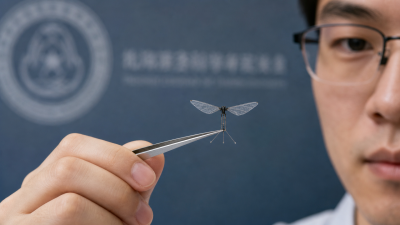
On 16 June 2026 China’s National University of Defence Technology (NUDT) unveiled a mosquito-sized surveillance drone for covert reconnaissance in a report aired on CCTV‑7.
Design and technical features
- Form factor: Mosquito-sized, stick-like fuselage with two leaf-shaped wings and three hair-thin legs; an alternative prototype uses four wings.
- Classification: Insect-scale micro‑UAV / flapping‑wing micro air vehicle (FWMAV).
- Components: Miniature actuators, MEMS sensors and microbatteries constrain endurance and payload capacity.
- Payload capability: Limited to micro‑cameras, microphones or environmental sensors due to strict weight limits.
Operational role and detectability
- Primary mission: Battlefield reconnaissance and intelligence collection in sensitive environments.
- Detection characteristics: Sub‑visual size reduces radar cross‑section and naked‑eye detectability; may bypass conventional radar thresholds.
- Control and communications: Prototype controllable via smartphone, implying short‑range radio links and associated signal security considerations.
Civilian applications and regulatory issues
- Civil uses: Environmental monitoring and agricultural research cited by developers.
- Privacy and legal implications: Insect‑scale surveillance raises domestic privacy, data‑protection and airspace regulatory questions.
- Regulatory gap: Many civil UAS rules are weight/altitude‑based and may not explicitly cover insect‑scale MAVs.
IASPOINT Booster Facts
- Developer & date: NUDT unveiled the system on 16 June 2026; report shown on CCTV‑7.
- Technical term: FWMAV denotes flapping‑wing micro air vehicles inspired by insect flight biomechanics.
- Performance constraint: Endurance of insect‑scale MAVs is typically measured in minutes due to power‑density limits of microbatteries.