
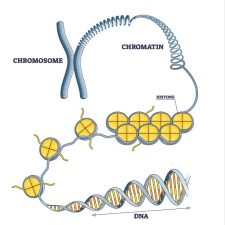
Inside every human cell, nearly two metres of DNA are packed into a nucleus just a few micrometres wide. This remarkable feat is achieved through chromatin — a DNA–protein complex that does far more than act as molecular storage. How chromatin is physically arranged determines which genes are switched on, which remain silent, and how the genome responds to stress, ageing and disease. A new study published in Science shows that an unexpectedly subtle factor — the spacing between DNA–protein units — can dramatically alter chromatin’s behaviour.
What chromatin is and why its structure matters
DNA inside the nucleus is wrapped around bead-like protein complexes called histones, forming repeating units known as nucleosomes. Short stretches of exposed DNA, called linker DNA, connect one nucleosome to the next. Together, these form chromatin, which allows dense packing of genetic material while still permitting access to genes when needed.
Crucially, chromatin is not uniform. Some regions are loosely packed (euchromatin), making genes accessible for transcription, while others are tightly packed (heterochromatin), restricting gene activity. Understanding how cells regulate these physical states — without altering the DNA sequence itself — has been a central question in molecular biology.
A small structural change with large consequences
The new study, led by Michael Rosen of UT Southwestern Medical Center, demonstrates that variations of just a few DNA base pairs in linker length can shift the entire physical behaviour of chromatin. Because DNA is twisted rather than straight, even small changes in spacing alter how nucleosomes are oriented relative to one another.
These orientation changes propagate along the chromatin fibre, reshaping how different strands interact. As a result, chromatin made of identical DNA and identical proteins can behave very differently — not because of chemistry, but because of geometry and physics.
How the experiments were done
To isolate this effect, researchers built chromatin in the laboratory using the same DNA and histones, changing only the linker length by five base pairs. Using rapid freezing and high-resolution imaging, they directly visualised individual nucleosomes and tracked how chromatin clusters formed, fused and broke apart.
This approach allowed them to watch chromatin behaving almost like a material — forming structures that could be solid-like or fluid-like depending purely on spacing.
Two physical states of chromatin
The results revealed a striking divide. Chromatin with shorter linker DNA stayed more open, allowing nucleosomes to reach outward and interact with neighbouring strands. These interactions produced densely connected, mechanically resistant clusters that fused slowly and were difficult to break apart — behaving like elastic materials such as toothpaste or putty.
Chromatin with slightly longer linkers behaved very differently. It folded inward, with nucleosomes interacting mainly within the same strand. This reduced inter-strand connections, producing clusters that were more fluid, less stable and easier to dissolve — closer to a simple liquid.
Why this matters for genome organisation
According to Yamini Dalal of the National Institutes of Health, the findings unify long-standing ideas about chromatin as a self-organising system. The study shows that genome organisation can emerge from chromatin’s physical properties alone, without additional molecular instructions.
When similar packing patterns were observed in human and mouse cells, it suggested that the same physical rules apply inside living nuclei as in controlled laboratory systems.
Limits of biological fine-tuning
At the same time, researchers caution against over-interpreting the results. Precisely maintaining five-base-pair differences across the entire genome would be difficult in living cells, where chromatin is highly dynamic. These effects may therefore be most relevant in highly ordered regions, such as repetitive DNA sequences.
Disruption of such regions is already linked to genome instability, cancer and ageing. The study offers a physical framework for understanding why these genomic areas are particularly fragile.
Implications for gene regulation and cell identity
From a functional perspective, the findings raise an important possibility: that chromatin’s physical state itself could influence gene regulation across different cell types. Sarah Teichmann of University of Cambridge and co-founder of the Human Cell Atlas has suggested that large-scale cell-mapping projects could test whether such physical chromatin states vary systematically between cell identities.
If confirmed, this would add a new layer to our understanding of gene regulation — one rooted not in DNA sequence or chemical modification, but in the material physics of chromatin.
What to note for Prelims?
- Structure of chromatin, nucleosomes and histones
- Difference between euchromatin and heterochromatin
- Role of linker DNA in chromatin organisation
- Concept of genome organisation beyond DNA sequence
What to note for Mains?
- How physical properties of chromatin influence gene expression
- Non-genetic regulation of the genome
- Links between chromatin organisation, disease and ageing
- Interdisciplinary approaches combining biology and physics
The study underscores a powerful idea: the genome is not just a code, but a physical object. How it bends, twists and packs may be as important for life as the genes it carries — reshaping how we think about regulation, disease and cellular identity itself.
Last Modified: December 29, 2025