
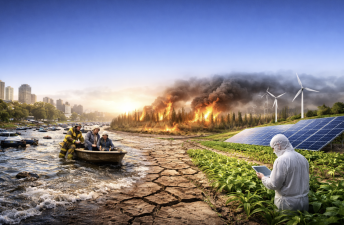
Climate change is now a daily reality affecting millions worldwide. Recent years have seen more frequent extreme weather events like floods, droughts, and heatwaves. South and Southeast Asia face severe floods, while Africa suffers long droughts. These events disrupt lives, economies, and ecosystems. This new era demands urgent adaptation and mitigation efforts.
Changing Climate Patterns and Extreme Weather
Climate change no longer unfolds slowly. Weather patterns have become unpredictable. Floods occur earlier and with greater intensity. Storms grow stronger and droughts last longer. Traditional seasonal cycles are breaking down. Warmer air holds more moisture, causing heavier rains. At the same time, increased evaporation dries soils faster. This creates a climate of extremes with floods and droughts often alternating.
Impact on Vulnerable Regions and Communities
Regions like South and Southeast Asia are highly vulnerable. River deltas, coastal plains, and mountainous watersheds suffer most. Countries such as Bangladesh, Indonesia, and the Philippines face repeated floods and landslides. These disasters destroy homes, infrastructure, and farms. Millions are forced to migrate, often to overcrowded cities lacking adequate housing and services. This migration increases social inequality and strains urban resources.
Economic and Social Consequences
Unpredictable weather disrupts agriculture, the livelihood of millions. Farmers cannot rely on past seasonal patterns for planting. Crop failures increase, threatening food security. Governments spend more on disaster relief, diverting funds from health, education, and development. Urban centres struggle with growing populations and inadequate infrastructure. Climate change thus deepens poverty and social challenges.
Adaptation Strategies and Future Outlook
Adaptation is critical alongside emission cuts. Investments in flood defences, early warning systems, and climate-resilient farming are needed. Nature-based solutions like restoring mangroves and wetlands can reduce disaster risks. Long-term planning must integrate climate risks into infrastructure and public health. Without emission reductions, disasters will worsen and become more frequent. The era of permanent climate uncertainty has arrived.
Topics for Prelims:
Climate Change and Extreme Weather
- Climate change causes more frequent floods, droughts, and heatwaves.
- Warmer air holds more moisture, increasing rainfall intensity.
- Evaporation speeds up, causing longer dry spells.
- Seasonal weather patterns are becoming unpredictable.
- Floods and droughts often alternate in affected regions.
Climate Vulnerability in South and Southeast Asia
- River deltas, coastal plains, and mountainous watersheds are highly vulnerable.
- Bangladesh, Indonesia, and the Philippines face repeated floods and landslides.
- Disasters cause displacement and damage to homes and farms.
- Millions migrate to cities, increasing urban stress.
- Infrastructure and social services in cities are often inadequate.
Adaptation and Mitigation Measures
- Flood defences and early warning systems help reduce disaster impact.
- Climate-resilient farming methods protect food security.
- Nature-based solutions like mangrove restoration reduce flood risks.
- Long-term planning must include climate risks in infrastructure and health sectors.
- Cutting greenhouse gas emissions remains essential to limit future disasters.
Questions for Mains:
- Discuss in the light of recent climate patterns how extreme weather events impact socio-economic structures in vulnerable regions. [GS-III-Environment & DM]
- Critically examine the role of nature-based solutions in climate change adaptation with suitable examples. [GS-III-Environment & DM]
- Explain the challenges of urban migration caused by climate change and discuss policy measures to address these challenges. [GS-II-Governance]
- With suitable examples, discuss how unpredictable seasonal cycles affect agriculture and food security in South Asia. Comment on the role of government interventions in this context. [GS-III-Economic Development]
Answer Hints:
1. Discuss in the light of recent climate patterns how extreme weather events impact socio-economic structures in vulnerable regions. [GS-III-Environment & DM]
- Extreme weather events like floods, droughts, and heatwaves have increased in frequency and intensity due to climate change.
- Vulnerable regions such as South and Southeast Asia face repeated disasters disrupting livelihoods, infrastructure, and settlements.
- Agricultural productivity declines due to unpredictable rainfall and crop failures, threatening food security and farmer incomes.
- Disasters force migration from rural to urban areas, straining city resources and increasing social inequality.
- Governments divert funds to disaster relief and rebuilding, impacting investments in health, education, and development.
- Overall, socio-economic structures weaken as poverty deepens and resilience remains low in affected communities.
2. Critically examine the role of nature-based solutions in climate change adaptation with suitable examples. [GS-III-Environment & DM]
- Nature-based solutions (NBS) like mangrove restoration and wetland conservation help absorb floodwaters and protect coastlines.
- NBS enhance biodiversity, improve ecosystem services, and increase resilience to climate impacts.
- Examples – Mangrove forests in Sundarbans reduce cyclone damage; wetlands in Southeast Asia mitigate floods.
- They are cost-effective and sustainable compared to engineered infrastructure but need long-term commitment.
- Limitations include land use conflicts, slow establishment, and dependence on local community engagement.
- NBS should complement, not replace, structural measures and emission reduction efforts for comprehensive adaptation.
3. Explain the challenges of urban migration caused by climate change and discuss policy measures to address these challenges. [GS-II-Governance]
- Climate-induced displacement leads to rapid urban migration, overwhelming housing, sanitation, and infrastructure in cities.
- Urban areas face increased unemployment, social inequality, and pressure on health and education services.
- Informal settlements grow, often lacking basic amenities and increasing vulnerability to disasters.
- Policy measures include developing affordable housing, upgrading urban infrastructure, and improving social services.
- Integrating climate resilience into urban planning and promoting decentralized development can reduce migration pressure.
- Governments should support livelihood diversification and provide social protection for climate migrants.
4. With suitable examples, discuss how unpredictable seasonal cycles affect agriculture and food security in South Asia. Comment on the role of government interventions in this context. [GS-III-Economic Development]
- Unpredictable monsoons cause floods and droughts, disrupting sowing and harvesting schedules in South Asia.
- Crop failures increase, reducing food production and threatening food security for millions dependent on agriculture.
- Example – Erratic monsoons in India cause simultaneous floods in one region and drought in another, impacting yields.
- Farmers face income instability and increased debt, affecting rural economies and livelihoods.
- Government interventions include promoting climate-resilient crop varieties, crop insurance schemes, and improved irrigation.
- Early warning systems, extension services, and investment in agro-meteorological research aid adaptive farming practices.