
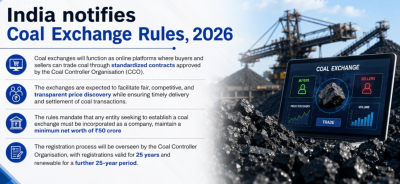
The Ministry of Coal has officially notified the Coal Exchange Rules, 2026 in the Gazette, establishing the country’s first regulatory framework for electronic coal and lignite bourses. This policy intervention stems from the recently enacted Mines and Minerals (Development and Regulation) Amendment Act, 2025, which introduced the baseline concept of a Mineral Exchange. Designed to shift the sector away from rigid, long-term bilateral linkages, the rules set up a structured marketplace for electronic trading. The policy aims to support industrial growth and energy market modernizations under the national roadmap for a self-reliant, developed India (Viksit Bharat).
Regulatory Supervision and Enforcement Institutional Setup
The execution of the electronic trading framework falls under a centralized regulatory body to guarantee compliance and standardized trading across all operators.
- Designated Regulator: The Coal Controller Organisation (CCO) serves as the statutory authority responsible for registering, auditing, and supervising all operational coal exchanges.
- Licensing Lifespan: Approved entities receive operational licenses valid for 25 years, with an option for renewal for another 25 years.
- Corporate Eligibility Criteria: Operators must structure themselves as demutualised corporations holding a minimum net worth of ₹50 crore to secure an exchange registry.
Transition to many-to-many Market Model
The fundamental objective of the rules is to dismantle traditional monopolistic supply routes and diversify market participation.
The “Many-to-Many” Paradigm
The domestic coal trade has historically operated on a “one-to-many” or “single-seller” blueprint, dominated largely by state-run suppliers and specific captive allocation routes. The 2026 framework establishes a decentralized, open platform where multiple certified sellers and multiple buyers interact directly. Commercial miners, captive miners disposing of permissible surplus stocks, and public sector undertakings can place their inventories on a unified electronic platform.
Transparent Price Discovery Mechanism
By shifting transactions to open electronic bidding, the framework eliminates information asymmetries in the fuel supply chain. Prices fluctuate based on real-time supply and demand metrics rather than administrative indexing. This transparency minimizes price distortions, stabilizes fuel sourcing budgets for critical downstream industries, and helps public sector units optimize their market capitalizations.
Market Integrity and Structural Governance Measures
To prevent speculative volatility and market manipulation, the rules build strict operational guardrails directly into the system.
Mandatory Physical Delivery
Every financial transaction executed on the regulated exchange must culminate in actual physical delivery of the coal asset. Speculative paper trading without logistics intent is restricted. All shipments undergo independent, third-party sampling and testing at dispatch points to ensure cross-verification of mineral grade and quality metrics.
Anti-Cartelisation and Financial Safeguards
- Shareholding Restrictions: Individual investors or entities are subject to a strict 5 percent ownership cap in any registered exchange.
- Governance Safeguards: Active trading participants and market brokers are barred from holding board positions or controlling administrative governance systems.
- Default Protection: Exchanges are legally mandated to maintain a functional Settlement Guarantee Fund (SGF) to neutralize counterparty default risks.
- Audit Trails: Advanced electronic surveillance systems must track order execution patterns to prevent artificial price fixing or regional cartelisation.
Comparative Operational Shift in Indian Coal Sector
| Parameter | Traditional Sourcing System | Post-2026 Coal Exchange Framework |
| Market Architecture | One-to-Many (Bilateral linkages / administrative auctions) | Many-to-Many (Open electronic platform) |
| Primary Regulator | Direct Ministry of Coal / Coal India administrative controls | Coal Controller Organisation (CCO) as market regulator |
| Pricing Blueprint | Fixed notified pricing or closed fuel supply agreement bidding | Dynamic market-driven discovery via open digital bidding |
| Sourcing Options | Tied to specific state mines or rigid geographical allocations | Wide pool access allowing diversified supplier picking |
IASPOINT Booster Facts for UPSC
- MMDR Amendment Act 2025 Foundation: Section 3(af) was inserted into the parent MMDR Act of 1957 to define a “Mineral Exchange” as an electronic platform for transactions in minerals, concentrates, or processed metals, while Section 18B empowers the Centre to frame rules.
- Indian Bureau of Mines (IBM) Parallel Role: While the CCO regulates exchanges handling coal and lignite, the IBM has been separately appointed to register and regulate mineral exchanges handling non-fuel major minerals.
- Captive Mine Liberalization Link: The 2025 legislative amendment completely removed production sale limits on captive mines after they meet requirements for their linked end-use plants, producing the surplus volume needed to feed these new exchanges.
- Lignite Inclusion: The scope of the 2026 rules extends fully to brown coal (lignite), allowing major electricity-producing states like Tamil Nadu, Gujarat, and Rajasthan to trade their localized deposits through the platform.
